Thursday, July 27, 2023

PhD sketchbooks: SBA (16/3/19 - 17/7/19)

The first in the SB (small book) series! I like to use several sketchbooks at the same time. If I'm working on a load of stuff in one of them (such as responding to things I'm reading, or doing a load of images for a publication that need to be batched together) then I don't want to interrupt that with something else that needs to go straight into a sketchbook. Also, they can 'talk' to each other, rather than just having a linear chronology of them. Sometimes I like doing things on different sizes of paper, so I use different sized sketchbooks. 

(Timelapse video of this one here!)

There's a lot of character design stuff in this one. 

Planetary stuff with Bridget and William. (See this post about IBB for some context about how I'm using planetary correspondences in interpretation/ character design.) I thought Bridget would be more solar (associated with power, responsibility, generosity, health, friendship, and other things that would be useful skills in efficiently running an extended household, while also suggesting that she is bright and lively but we don't know much about her!) and I had William down as lunar (quiet, thoughtful, secretive, rarely seen sometimes) but then I later decided that he's much more Saturnine.

Developing William and Charley using contrasting contemporary concepts. I aligned William with the Enlightenment and with William Blake's ideas about Reason, and I associated Charley with Romanticism and Blake's ideas about the Imagination. Also I noticed (through observation and doing a bit of presenting) that lecturers and people in similar occupations usually move in a specific way: the elbows-in people take up less space and move their arms from the elbow down (this is the more common way of doing it) while the elbows-out people move much more dynamically (this is the group I fall into). I use this when I draw William and Charley teaching.

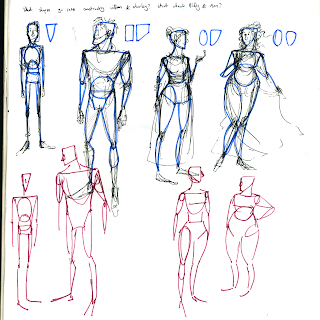
Using William and Charley's body shapes to explore potential power dynamics. William is at the top of the hierarchy at Bowes Academy, but he's small and skinny. Charley is second in command, but much bigger and more muscular.

I've also got loads of notes from books I'd read. Here's some from Romantics: Their Lives, Works and Inspiration (edited by Nathaniel Harris, published by Marshall Cavendish Books Ltd, London, 1991) - I used some of the poets' portraits to develop Charley's clothing, specifically his relaxed attitude to neckwear.

I also used contemporary concepts (specifically Beauty and Sublimity, as described by Edmund Burke) in developing Ann and Charley. There aren't many traces of Ann's life left (parish records, censuses, the Mackay family bible, that's about it), certainly fewer than her husband Charley (the same things as Ann plus his adverts when he ran his own school, and newspaper reports about the ophthalmia trials), so I wanted her to seem very interesting and the sort of person you might want to be friends with - and then hopefully my poor audience feels frustrated that we know so little about her!

So I aligned Ann with the concept of Beauty, and Charley with Sublimity. Burke says that Beauty "inspire[s] sentiments of tenderness and affection" while the Sublime surprises and scares people (while not necessarily being actually dangerous). But this sort of thing got problematic - I wanted to make my audience think that Ann and Bridget were more preferable to their schoolmaster husbands, so I made them too nice and not complex enough, which made them a bit one-sided compared to Charley and William. So I need to develop them further! (Likely postdoctorally now.)

I also looked at contemporary educational materials - I'd picked up an undated copy of Vyse's New London Spelling Book at a car boot sale for £2 - it first came out in the 1770s, and is the sort of thing that William and Charley would have used to teach the boys. It's full of all this moralising instructive stuff. Here's a copy from 1813 (which resembles my undated copy), and here's a highlight story thing on my Instagram in which I explore my copy and explain some of its weirdness.

Some of the drawings are directly relevant to my case study, like the trial, but others are silly/ metaphorical. It's useful to look at the sort of things the people in your case study might've used, even if you can't draw a direct link - it's still stuff they'd have been familiar with. In addition to Vyse, some of the 'advice' on these pages also appears in this book.

Another experimental thing - using colour/ scribbles to explore/ suggest emotional states. Can I communicate vibes without words?


Then more trying to capture/ evoke/ communicate moods without words. These are the final two spreads in the book. I can't remember if I was experiencing any (worse than usual) psychological disturbances when I drew these - quite often, when I have those, I draw William and he gets it too. Sometimes these drawings are the only trace of those experiences. Everything that happens to me becomes material that I can use! (I'm secretly an optimist)


I think I might've been overwhelmed by something (or a mass of somethings) so I wondered whether William might have felt overwhelmed by all his responsibilities. Genuinely can't remember!

Anyway! That's that for this sketchbook. Here is the list/ sketchbook index if you want to see another.

Wednesday, July 26, 2023

PhD sketchbooks: IBC (15/9/19 - 9/11/19), IBD (9/11/19 - 20/2/20), and IBE (20/2/20 - 17/3/20)

Three sketchbooks in one post! (Time-lapse video of all three here!)

IBC (15/9/19 - 9/11/19) is mostly notes on lectures, books, etc., but does have some fun stuff. Here's when I was redesigning Bridget to make her more of a visual contrast to William - she used to look like this. 


Left hand page: thinking about things I did in the North, late summer/ early autumn 2019. Highlights include imaginative engagement with a lot of stuff in Barnard Castle, and going to various places on the Great North Road (where William and other schoolmasters would have travelled along when they did their twice-a-year London trips).

Charley showing some element of self-awareness, before I properly started interrogating/ exploring that sort of thing. He's a character I've created, and he lives in my head, so he knows that I'm interested in interrogating historical traces. (This is in the middle of some conference notes)


IBD (9/11/19 - 20/2/20) contains what might be the earliest seeds of what became (Un)Known Associates. 
Right hand page: early ideas for Tarot cards! Lower left corner of left hand page: some image of two Williams, one screaming and the other apparently fine, which kept recurring through my work, notably in Disorder and a set of acrylic painted panels I made (specifically this one)

Worked up the Tarot ideas, and drew from photographs I took at Bath Fashion Museum.

Another recurring image: William upside-down. Turns up in Disorder and in (Un)Known Associates. (Those links show those specific images, not the whole entire publications.)

More museum costume reference from that trip to Bath in January 2020. I like trying characters out in different costumes to see what happens, see if I can use those to change how I interpret them or how I can make them move. It's fun seeing how you can use costume to say things about people, such as hints towards their economic status or how they might want to present themselves. Some of these clothes might be out of date, or too high-fashion, for my characters, but it's good to experiment!

Right hand page: outfits from two Derby plaques, c. (early?) 1820s, in the Victoria Art Gallery in Bath. I have no idea what Bridget and Ann looked like, or what they would have worn - Bridget looks stylish but practical, and Ann looks like she's off to a party - drawing costume allows you to interrogate it more closely than if you just glanced at it! Drawing makes you look and helps engage your imagination.

Based on items in Bath Fashion Museum. These are clothes that survived, unlike loads of other traces of the past. Also, on the right hand page, Mary Ann wears a pelisse (long coat) that she ended up wearing in one panel of Disorder.

IBE (20/2/20 - 17/3/20) begins with a lot of notes about books, etc., but also includes more costume reference.

Planning a trip to Bowes just before the first UK lockdown. Includes a relatively early instance of William being self-aware and criticising my ideas. (I discuss this sort of thing in my thesis.)

Ideas from trips around various places. Sometimes seeing things in museums can set off good ideas, such as on the right hand page, when I saw a display about medical care at the Dales Countryside Museum at Hawes, which set me off thinking about local apothecary/ surgeon Henry Benning who probably had to be on call at all times. (I don't think he was called Dr Benning? That we know of? I don't think it was his official title, but there's no way of knowing whether people he knew insisted on calling him it.)

Right hand page: Bridget wears a silk day dress, 1828-30, which I saw in York Castle Museum. She ended up wearing a version of it in Disorder (set around 1820-21) and other drawings. Even though the garment itself is later, I thought it seemed suitable for her as a character - I designed her to contrast with William, and I represent her as being quite exuberant compared to his reticence, so yes let's give her massive sleeves


The dress I adapted for Bridget at York Castle Museum's Shaping the Body exhibition. I love museums, I like to go window-shopping for things for my characters

In the next instalment: more museums! Church windows! Lockdown! Despair! The beginnings of Disorder!

Return to the sketchbook list here.

PhD sketchbooks: IBB (20/8/18 - 14/9/19)

Following on from the previous sketchbook, I was trying to do some kind of reconstruction of what might've happened during a few minutes one morning at Bowes Academy. (Time-lapse video here!)

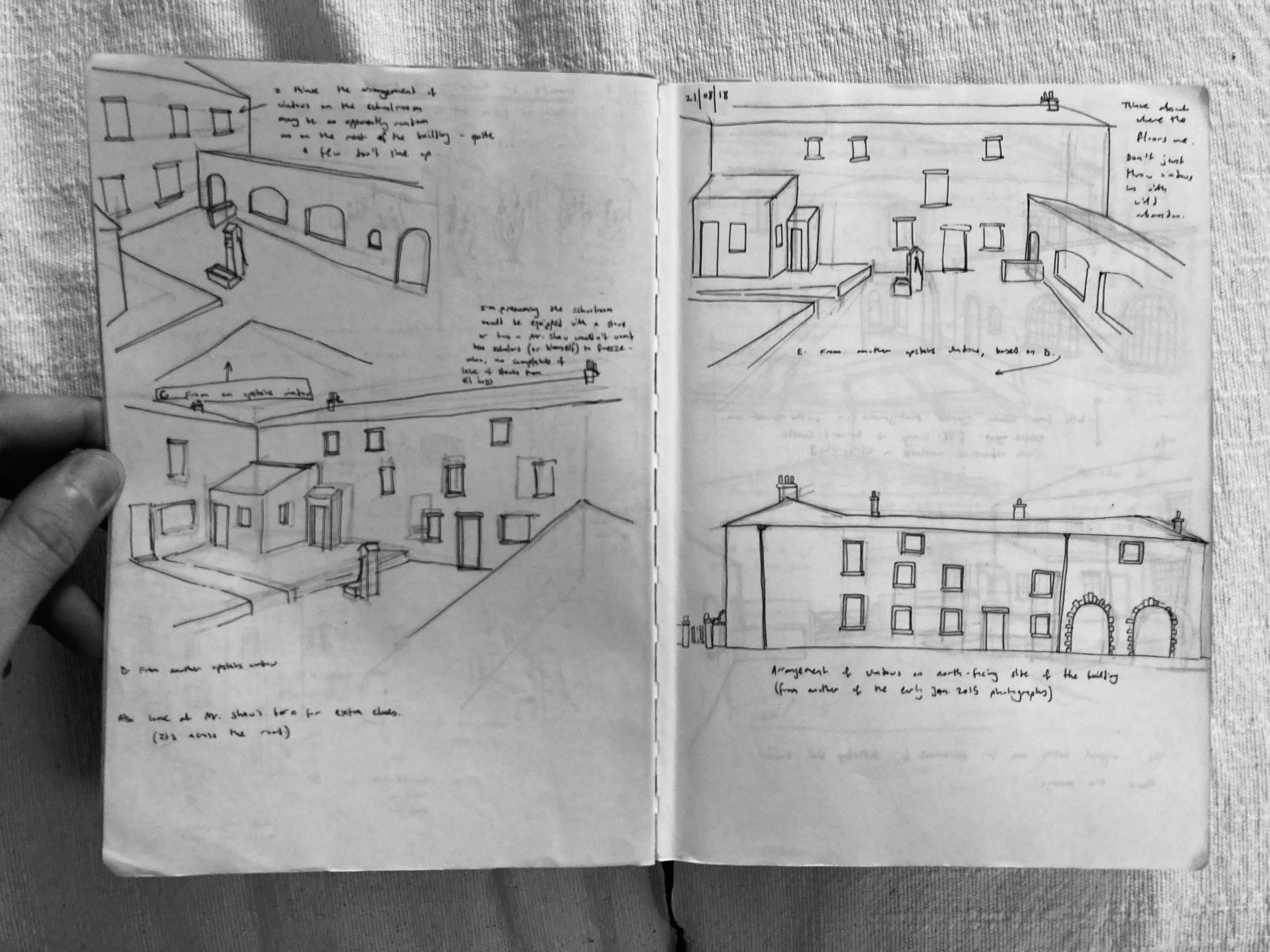
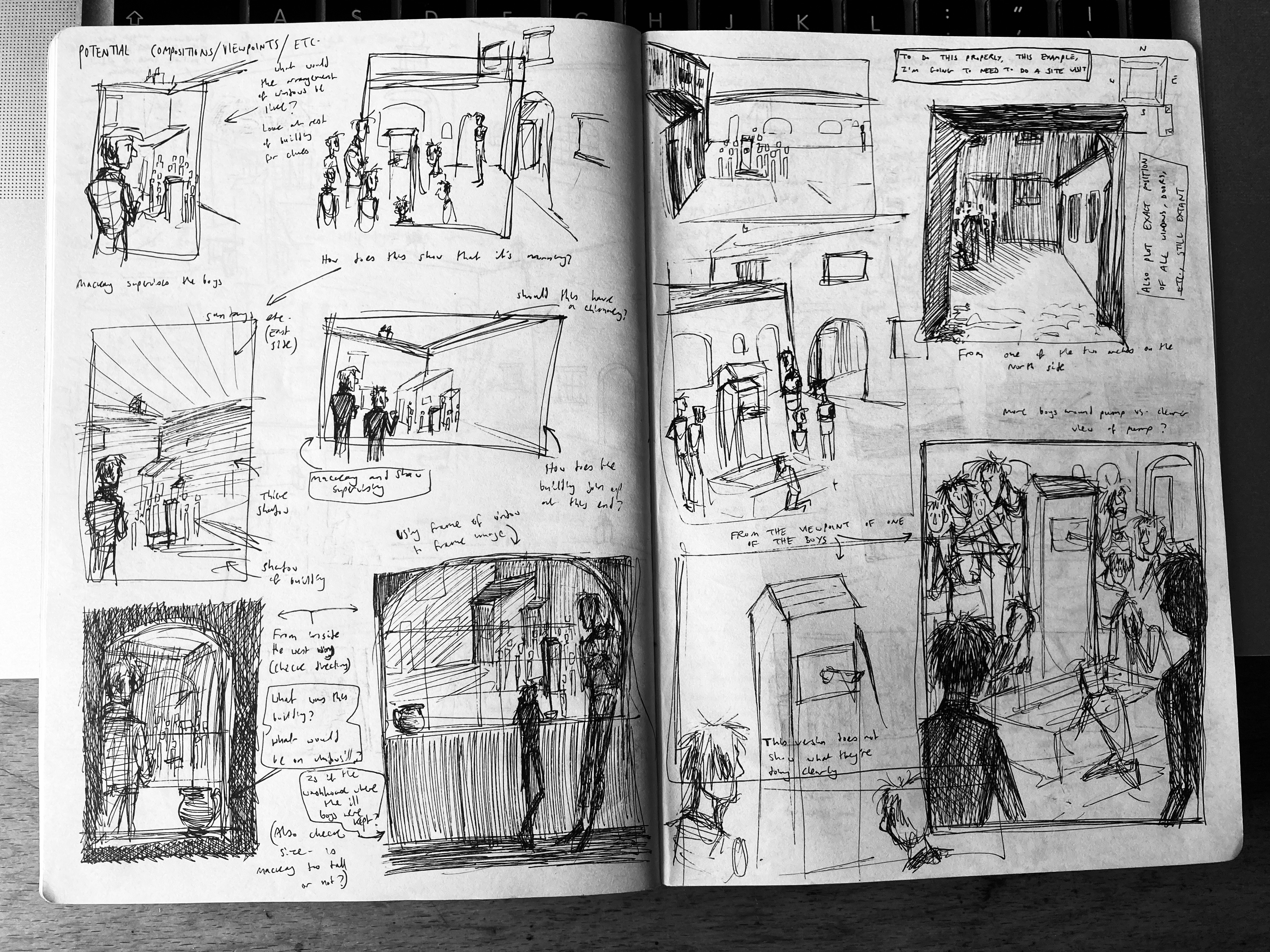
Some views around the building. Entirely speculative, from viewpoints that I couldn't access in real life, and some have my imagined version of what missing parts of the building might have looked like. 

Trying to work out what Charley wears, using extant garments and fashion plates in museum collections. 


Then Charley suddenly got cheerful? (I think he must've been hung over earlier)


Right-hand page: I decided to set the pump illustration in the winter of 1820-21. Reasons include: there's people there whose evidence about the place survives (the Jones brothers at the trial, and Horatio Lloyd who wrote about his schooldays), there's other people there who I've already designed as characters, there's weather that would have affected people's behaviour, the ophthalmia was doing the rounds, some very good coats come out in winter, also very dramatic lighting, very good fun to draw.

By this point I was starting to read some historiographical theoretical stuff. Here's a response to something in Marc Bloch's The Historian's Craft, where he said how difficult it can get to adequately explain people's experiences in words. I tried using a comic to show what William Jones might have experienced when he caught ophthalmia and was banished to the washhouse. Not sure it worked all that well: just showing his reaction and what he sees is all well and good, and it functions as an example of how strongly evocative images can be compared to words, but it's still my imaginings. If I'm trying to adequately explain somebody else's experiences (in words or images) it's not really going to work because I'm not them! (Don't get me started on whether they'd succeed at it, either, whether they'd want to tell us accurately, whether they'd want to portray different versions of events/ different truths to different people, whether they might not remember some bits, oh no we'll be here all day)

Probably the last time I did anything with the pump reconstruction. 

Also more visual notes, this time about the ophthalmia trials. This was just before I redesigned William's face! (He used to look different in my older work.)

These next few spreads are from when I tried designing William - more on that in this post.


More visual speculations based on written sources. Just noticed that I have a tendency to veer off into jokes with these:

According to Horatio Lloyd, who attended Bowes Academy in the early 1820s, William Shaw would play the flute to entertain boys who were unwell. In what other contexts might he have played it? What might other people have thought about it? (I keep forgetting about Lloyd's mention of the flute business - I haven't seen it anywhere else - scroll down this page to see it)

Messing about with one of William's adverts, from the York Herald, 28 June 1834. 

A lot of this sketchbook is notes on lectures and books. Before I started the PhD, I emailed my university's History department asking them for book recommendations - they gave me some, and kindly invited me to join their HM5001 lectures on historiography, methodology, theory, etc., and that's where I picked up my love of that kind of thing. (Now when I see any mention of historians not wanting to engage with theory, or philosophy of history, or anything like that, I'm like "WHY?! It's FUN, you are missing out")

Notes on a lecture given by my wonderful supervisor Melanie about three types of historians - reconstructionists, constructionists, and deconstructionists - this is when I started to realise I'm a deconstructionist.

The next couple of spreads are about bringing some occult influences into my work, specifically using planetary correspondences (using the seven classical planets) to play with character design/ interpretation. For instance, Saturn is sometimes associated with time and death (I'm a historian, these are relevant), and also with melancholy, responsibility, practicality, austerity - all things I associate with my interpretation of William.


Left hand page: associating Charley with Mars (energetic, strong, quarrelsome - I don't know what happened between him and William that resulted in Charley leaving in the early 1830s), and associating Bridget with the Sun (friendship, health, wealth and prosperity, harmony, optimism, dignity)


Also in this book - some drawings from photographs I took on a trip to Barnard Castle at the start of September 2019.

As with all these posts about my PhD sketchbooks, this is only a few pages from this particular book. For more sketchbooks, here's the list.

Tuesday, July 25, 2023

PhD sketchbooks: IBA (29/5/18 - 20/8/18)

This is the first in the IBA series, and I had it going from 29th May to 20th August 2018, which is before my PhD officially started, but I like to get ahead of things. (Time-lapse video here!)

The cover started off brown. Faded to... green?


I was trying to work out what I was going to do, regarding the case study - I knew it was going to be something related to those early nineteenth century Yorkshire boarding schools, but I didn't know what I'd focus on. One specific school? Some sort of theme that seemed to recur across a few of them?


Also some rummaging about in censuses, things like Ancestry/ FindMyPast/ etc (thanks to Monmouthshire Libraries for access via the computers at my local branch!)


I think the most exciting/ interesting/ useful thing in this book was the work I did towards an experiment that I never finished. I wanted to illustrate my proposal with an example of drawing used as a way of doing history. I was going to take (what I now realise is) a more traditional reconstruction drawing approach - get as many references as you can - and I thought I had to make it 100% accurate. It did not go to plan.

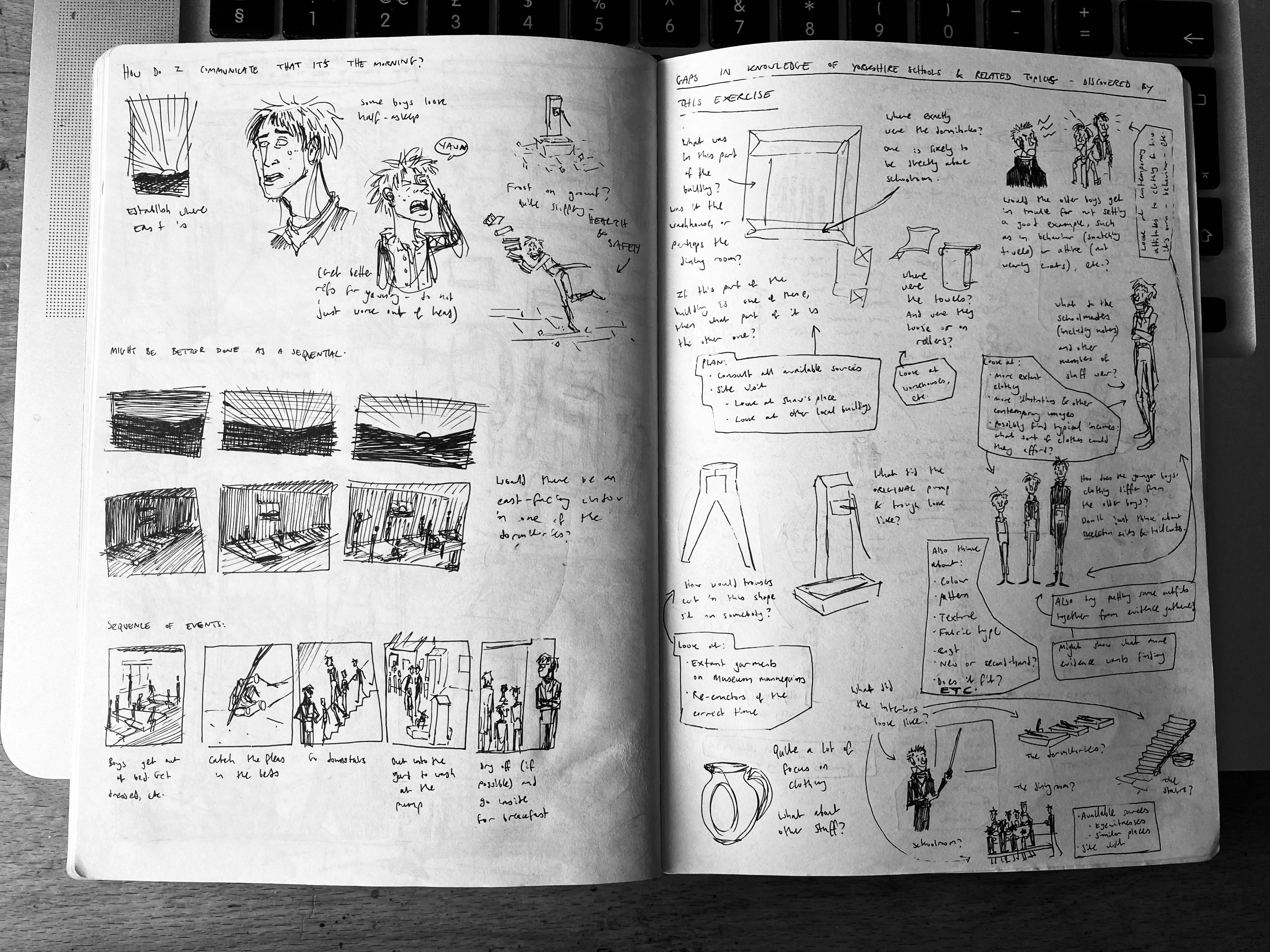
In the Jones vs Shaw trial (30 October 1823), William Jones mentioned that the boys would get up in the morning, flea the beds, then go downstairs into the yard to wash at the pump. I thought I'd draw that. It then spiralled out of control as I realised, through trying to draw that scene, how much I don't know - it started with costume reference, went onto the pump itself (the one currently in the courtyard dates from the 1850s!), how people might behave, what time of year is it, how do I convey that it's morning, what angle do I show it from, there's some parts of the building no longer there, should I do it as a comic/ sequential thing, where do I start - absolute minefield!


This (actually useful) minor fiasco continued into IBB, the next sketchbook in this series.

Return to the sketchbook list here.

Introduction to Ed's PhD Sketchbooks

The pile!

I'm making posts about all these! Click on the links below to see some of the most relevant/ significant/ interesting/ fun bits in each sketchbook:

IB series


SB series


A4B series

(Bonus content!) 

For some reason, I didn't usually mark the exact dates in the A4 series.


All of the above posts (except the bonus content post) have links to timelapse videos of each sketchbook, in which I flip through them and show you each page, just to show the sheer volume of work that I've done for my PhD.

Here's what I said about them in my thesis:

I created a reference system for my sketchbooks. PhD sketchbooks are typically indicated by a string of letters, followed by the date. The IB series are my main sketchbooks (IB stands for “investigation book”) and are approximately A5 when closed, or slightly smaller. The SB series (SB means “small book”) are usually around A6 when closed, and I also have an A4 series. Each book is then coded with a letter in alphabetical order, and each entry in each book is dated, with the exception of some entries around the start of my PhD before I had developed my system.

At time of writing (June 2023), the IB series runs to 16 books, the SB series to 8 books, and the A4 series to 6 books. I am currently using IBP, SBH, A4BA, and A4BF.

I also have work relating to my PhD, my case study/ characters, and potential future projects in other sketchbooks.

The IB series are those ones with the brown covers (although IBA's cover faded to green in some places). Apparently boys at Bowes Hall Academy (at the other end of the village, run by George Clarkson) used copybooks with brown paper covers, so it's a sneaky reference to that! Read John Crosse Brooks's memories here (but you'll have to log in, also be warned there is a grim account of boys attempting cookery with birds).

Brooks says "The books and stationery formed a prominent feature in the school advertisement. These, of course, were really provided, but the books were marvels for dirt and dogs' ears, and the writing and ciphering books were mere sheets of common paper stitched together, with coarse brown paper covers, all in the most primitive and most economical manner possible."


Friday, May 19, 2023

(Un)Known Associates - out now!

I've brought out another publication! It's a PDF! It's a deck of cards! It's an interactive thing that you can print out and use!

Here's the abstract:

(Un)Known Associates is an experimental tool for developing historiographical thinking, specifically referring to the creation of interpretations and to strengthening an understanding of the historical sublime. Itʼs a deck of cards, which are included in this guidebook, that can be used for creating your own narratives, and for exploring some aspects of the theory and philosophy of the discipline of History.

So basically it's about having a group of things (the cards) and interpreting stories out of them, kind of like how historians have a group of things (traces of the past/ 'sources') and interpret stories out of those.

In that way, it's similar to Disorder, but this time we've got an extra spicy bit: the historical sublime. The cards, like traces of the past, are ambiguous and open-ended, and we can't get logical linear narratives out of them (but we can try!).

It's a PDF, which you can view and download for free on Academia.edu and ResearchGate - if those links don't work, or it won't show up for you, give me a shout and we'll see what we can do.


It includes:

Brief words discussing William’s school, the historical sublime, Tarot/ Lenormand, and some of the imagery I’ve chosen

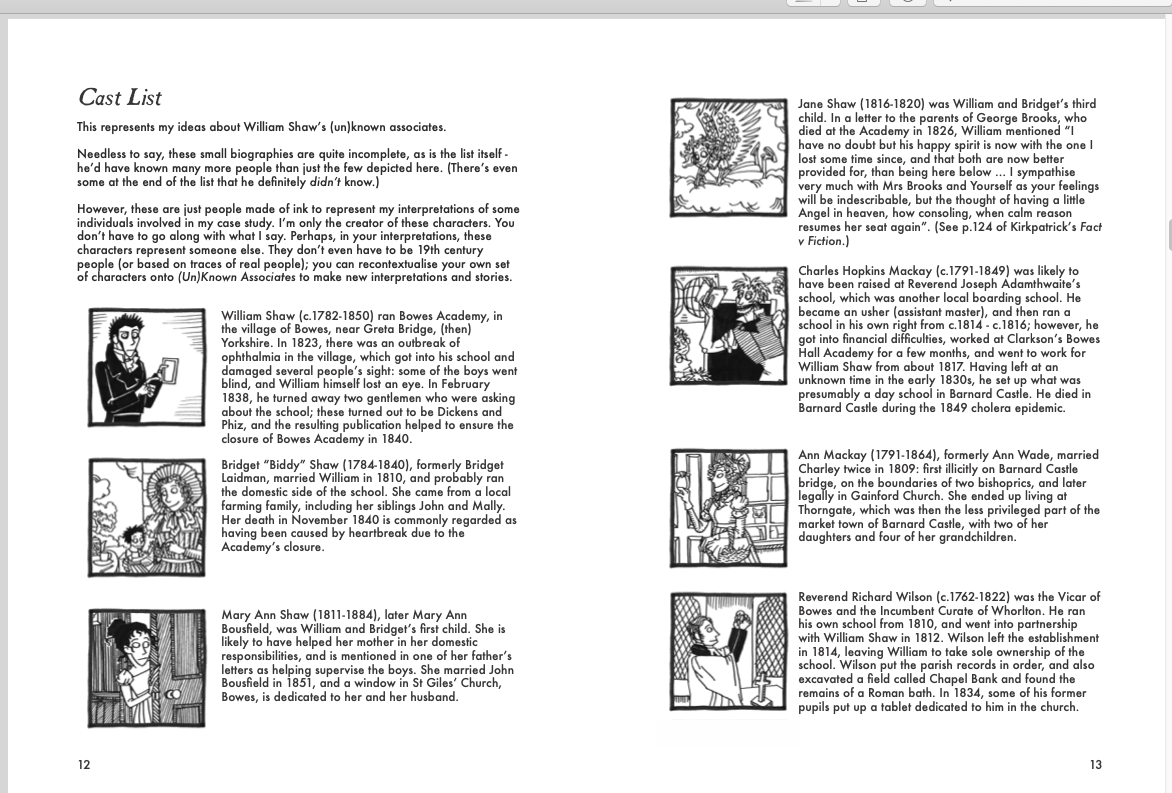
Cast list of the people I’ve drawn on the cards

Things you can do with the cards: ideas for spreads and games

Huge list of interpretations, if you want to understand them as Tarot/ Lenormand

Small bibliography


Download it, print it off (actually just print the cards, save some paper), and start experimenting with what you can come up with.


I have really got to stop sitting on projects and then suddenly bringing them all out at once, I brought Disorder out less than two months ago

Characterisation of Charley and Ann - or, Beauty and Sublimity

[Looks like I'd started writing this in 2021, and only now I am getting round to posting it. Hang about, we've got the word "su...