I started my BA in Illustration at the University of Gloucestershire in 2012. In my final year, our then head of department KP wondered about setting up the MA, for which I was well game - I wanted to see where I could take my illustration practice next, how I could push it in new directions, how I could use it for research. Then, towards the end of the MA, we started wondering about how the Illustration department could do a PhD - then there was a year of trying to get it off the ground - and then eventually, in the autumn of 2018, I started it!
(Exactly 203 years ago William was in London, meeting parents and new pupils, haha wow)
During the last year of my BA (2014-15), for my final major project, I researched, wrote, and drew a nearly-finished graphic novel about the terrible misadventures of a fictional boy at Bowes Academy. I went to archives, did site visits, generally had a great time... Unfortunately I was still heavily influenced by Dickens's Dotheboys Hall, and I had no idea how historians do what we do (I thought it was all about Finding The Facts haha wtf) and the result,
Bad Form, contained interpretations that I no longer support. (I'm glad I never finished it and it never saw the light of day.)
One of my reasons for doing my PhD about this case study was to see how my interpretations had changed. This slide shows how my depictions of Bridget and William changed (and my drawing style too). At the top of the slide is a panel from
Bad Form (2014-15), and then in front we've got Bridget and William from about 2019.
This was great - I asked the illustrators to shout their ideas at me, and fortunately they all said very sensible things about creating interpretations, going on site visits, viewing things in museums, and interviewing people who were involved or whose relatives were involved. I am relieved and delighted to say that nobody came out with any nonsense about 'finding the facts to tell the true story about what really happened in the past'!
We make evidence-based interpretations of traces of the past, using a load of other considerations! Unfortunately not everybody likes to acknowledge these. It's usually your more traditional historians who tend to forget themselves and their subjectivity and creativity and imagination and such in creating their interpretations.
I've got a blog post about Alun Munslow's categorisation of historians
here!
The past is gone and we can't get it back (which is not a bad thing when we think about various embarrassing situations). History is what historians make: it's how we communicate our ideas about the past.
When Dickens and Phiz went to Bowes, it's extremely likely that they saw Shaw, and used him as visual inspiration for the villainous Wackford Squeers, who, like William, is another short and peculiar one-eyed schoolmaster who wears a lot of black. Some of Shaw's old pupils recognised him in Phiz's illustrations, and Phiz's son asked him what the original was like, and Phiz said that the illustrations were
"not unlike him". So I used Phiz's Squeers, translated him into my drawing style, then de-exaggerated him to get an interpretation of what William's face might've been like.
Horatio Lloyd had gone to Bowes Academy in the early 1820s (evidently around or after the ophthalmia scandal, as he described William as having damage to one eye), and grew up to become a famous actor and wrote an autobiography which came out in instalments in the Glasgow Weekly Herald in 1886 (
read it here). He described the schoolmaster, which gave me clues about his physical appearance, including things to search for in museum collections online so I could give him clothes (extant costume and contemporary prints are your friends).
I don't like to build my characters one at a time - if I create a bunch all at the same time, I can bounce ideas around between them and make them contrast against each other more effectively. (And I like to revisit them and change them later! Never leave your characters set in stone - history is a constantly changing discipline, interpretations change all the time.)
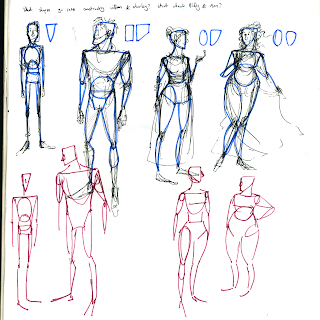
When I was building William, one of the others I was building at the same time was his head usher Charles Hopkins Mackay - I created Charley as my representation of my ideas about him. We don't have any evidence about what anybody else in my case study looks like apart from William (and some mid- to late-19th century photographs of
Mary Ann and
Jonathan, two of his and Bridget's children, and some of his ex-pupils). So nothing about Charley - so that means I have free rein to make him look how I like! (Within reason, I'd need to provide good explanations if I start doing weird things like turning him into a wolf or something hahaha whoops)
I wanted to use contrasting character designs to explore the potential power balance between the two schoolmasters. William is at the top of the hierarchy in Bowes Academy, and is physically small, Charley has less authority - what happens if I make him big and muscular?
I also used their adverts. Earlier we saw one of Shaw's adverts - he seems very professional and to-the-point. Mackay, meanwhile, is very verbose in his adverts, and goes off on tangents, and gives some slightly dubious autobiographies. (Scroll down
this pamphlet from 2019 to see a bit more on this.) I used this to give them contrasting behaviours in the schoolroom: William is very reticent, whereas Charley is much more expressive. (Based on my observations of the behaviours of lecturers and my own presenting style!)
I brought in some near-contemporary concepts from William Blake - Reason and Imagination. Reason is all passive, restrained, conventional, orderly, static, and tends to accept stuff. Imagination, on the other hand, is very active, energetic, revolutionary, dynamic, and tends to question and challenge stuff. Using the above business with the adverts, I aligned William with Reason and Charley with Imagination, which gave me another contrast to play with.
Single statements and broader interpretations! A single statement is more usually known as a 'fact'. This is a small thing. A work of history (usually containing a number of these) is a broader interpretation. For instance, this could be when your historian has put a bunch of single statements together and needs to join them up somehow, or when they've decided that this specific statement definitely means this, or when they build a narrative out of things - anything like that.
Here's our example. Charles Mackay was involved in teaching. Ok - we've got his adverts (just seen), and all these bits saying that he was an assistant in a school or he was operating on his own in some educational capacity. But what sort of teacher was he like?
We don't know what kind of teacher Mackay was! That's the broader interpretation. I can suggest different ideas about him using drawing, but these are interpretations, not facts. (I like to interpret him as being very enthusiastic but I genuinely have no idea.)
Traditional historians like to think that they can make things that correspond exactly (or close enough) with what really happened in the past, and for some reason it always looks like a very specific style of academic prose, usually with a linear narrative and some cause-and-effect and the meanings behind things and some sort of analysis and all that sort of business. I had no idea that the past was just words, and that it was so neat and tidy!
Correspondence theory is total wack and the next slide contains a very quick example as to why that is.
Neither of these things are William Shaw. One is a couple of words. The other is a drawing of a character that I created to represent my interpretations of what he might've been like at a certain point in his life. Neither of these are the man himself.
The things that I make do not correspond with what really happened in the past (whatever that might be). I can't show you exactly what this schoolmaster looked like, never mind how he behaved or what he thought, or any of the events he was involved with.
By doing history using drawing, rather than your traditional written history, I can point out that this is my subjective interpretation. I'm not hiding behind a wall of words. I created this - you can see where I moved the pen across the page. All those marks become traces of my activity, of my hand moving across the paper.
History should not be limited to a specific style of writing as not everybody is comfortable with writing (and it's even worse if you restrict it to only being allowed to do it in certain ways!). So we need experimental history: drawing, performance, re-enactment, film, music, sculpture, all sorts of fun stuff.
Some traditional historians don't like experimental history because they believe that none of these methods are nuanced and subtle, and none of them can have the proper references and all that. But if we don't experiment, then how are we going to be able to find out how to make them nuanced and subtle and referenced?
We're having another crack at correspondence theory. We're using experimental history to explicitly point out that our representations of our ideas about the past are not the past itself - that's what Alun Munslow is talking about when he says experimental history tackles the relationship between "the reality of the past and its correspondence in the text (or in any other mode of expression)".
Here's a selection of pages from my graphic history/ comic
Disorder. (Available as a free PDF via
this post.) In
Disorder, I explored an incident that I'd only seen mentioned briefly in a couple of trial reports: apparently, when Bowes Academy was afflicted by ophthalmia, William nearly died - his life was despaired of - presumably due to the stress of the situation. I used a few different visual languages (drawing styles) to speculate over what some of the people involved might have thought/ experienced at the time.
Every event will have multiple perspectives: everyone involved (or who witnesses it or hears about it later) will have different experiences and interpretations and such. Then we can have fun with memory, and with how they relate their tale/s to others, how they make sense of it themself, whether they can commit it to the historical record, whether it survives, who has power over which stories are preserved and which stories are told...
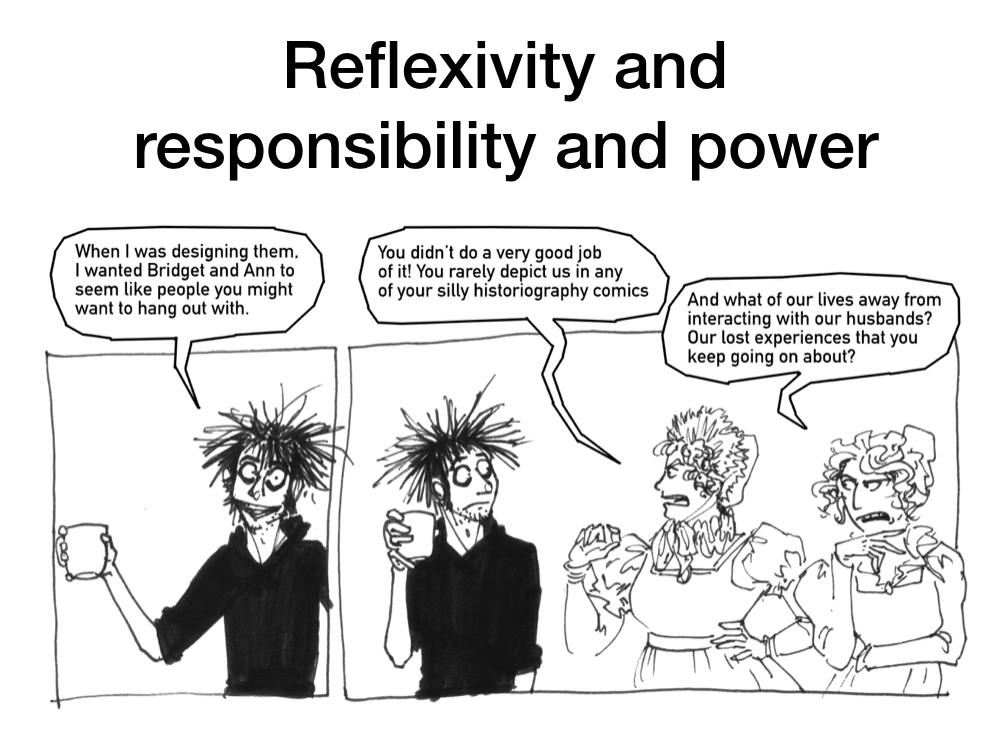
Which leads onto one of the uses of being reflexive about your practice, and thinking about what you do and how you do it: you become aware of your own responsibility and power in how you depict (your interpretations of) the people and events in your case study!
So in this comic (which is from my thesis), Bridget and Ann point out where I haven't done things that I should've done. I use these characters to provide alternative commentary on the stuff I discuss in my thesis, evaluating my work and wondering what might their originals have thought of the way I depict them?
Making your characters self-aware (aware that they are invented characters) is a useful strategy - it points out that, unlike what some more traditional (and anti-theory) historians might say, the history is not speaking for itself. These people are characters who I've made, and they know it. (Well, they themselves don't really, because they're made of ink, but anyway.)
In this slide, Mary Ann gets impatient with me (right-hand side) because I was meant to be painting her pages in
Disorder but I'd got distracted on costume reference and such. In the comic on the left-hand side, she's got access to my silly reference photos that I take - she exists in my imagination, so she's got access to all my stuff, including laptop passwords and knowledge of how to open the Photo Booth app.
Here's a thing that more conventional historians might find a bit trickier if they prefer to do things in writing - using yourself as drawing reference! I have limbs, I have a camera, I make my own pose reference.
Another fun thing you can use in building your interpretations: your own experiences. In November 2020, when I was working on the preliminary sketches for William's pages in Disorder (y'know, in which he nearly dies), my appendix ruptured, which was very inconvenient and somewhat exciting, and I had to have an emergency operation (massive thanks to the NHS for sorting that one out). During my stay in hospital, I barely managed one A5 side of drawing, but some of the imagery from that ended up in Disorder. I still think it's one of the funniest things that's ever happened to me.
By this point, I've been working with some of these characters for so long and at such intensity that it feels like they're just out of reach - they're part of my imagination, they contain parts of me, some of them are now part of me - but their originals are in the past and I can't access them because they're dead.
Blog post about the historical sublime
here!
An example from my work - in the early 1830s, Charles Mackay stopped working for William Shaw. I have no idea what happened. This is another gap for imaginative exploration. (I don't know whether they had a row or what, I just like drawing angry people and teeth)
And with that, we moved onto my recommendations for anyone wanting to take a closer look at deconstructionist history: