Showing posts with label things to make and do. Show all posts

Friday, May 19, 2023

(Un)Known Associates - out now!

I've brought out another publication! It's a PDF! It's a deck of cards! It's an interactive thing that you can print out and use!

Here's the abstract:

(Un)Known Associates is an experimental tool for developing historiographical thinking, specifically referring to the creation of interpretations and to strengthening an understanding of the historical sublime. Itʼs a deck of cards, which are included in this guidebook, that can be used for creating your own narratives, and for exploring some aspects of the theory and philosophy of the discipline of History.

So basically it's about having a group of things (the cards) and interpreting stories out of them, kind of like how historians have a group of things (traces of the past/ 'sources') and interpret stories out of those.

In that way, it's similar to Disorder, but this time we've got an extra spicy bit: the historical sublime. The cards, like traces of the past, are ambiguous and open-ended, and we can't get logical linear narratives out of them (but we can try!).

It's a PDF, which you can view and download for free on Academia.edu and ResearchGate - if those links don't work, or it won't show up for you, give me a shout and we'll see what we can do.


It includes:

Brief words discussing William’s school, the historical sublime, Tarot/ Lenormand, and some of the imagery I’ve chosen

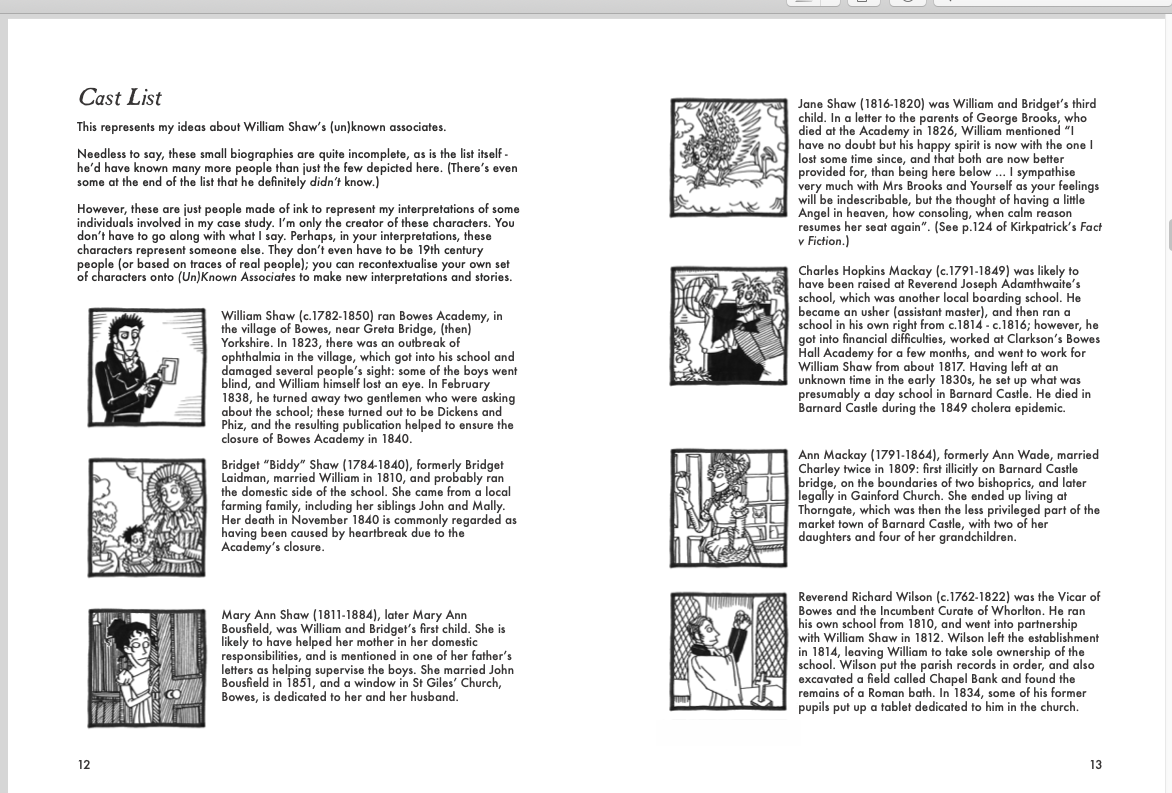
Cast list of the people I’ve drawn on the cards

Things you can do with the cards: ideas for spreads and games

Huge list of interpretations, if you want to understand them as Tarot/ Lenormand

Small bibliography


Download it, print it off (actually just print the cards, save some paper), and start experimenting with what you can come up with.


I have really got to stop sitting on projects and then suddenly bringing them all out at once, I brought Disorder out less than two months ago

Saturday, January 9, 2021

A few years’ difference - and free printable bookmarks!

Like most people who draw, I love seeing how my work has improved over time, and how the characters I draw change.

(There's a PDF with the free printables at the bottom of this post, for which you will need decent card, scissors, and possibly a responsible person to keep an eye on said scissors. I just want you to read all my tales first.)

Free bookmarks! Wahey!


When I was in the last year of my undergraduate course, around 2014-2015 (Illustration BA, University of Gloucestershire) we all had to set ourselves a final major project. Some people did children’s books, some did zines, I think there might’ve been animation going on somewhere, and I did a graphic novel about Shaw’s Academy. I wrote it all, and inked most of the final pages, but I never got round to finishing it, which I suppose is a good thing. It was badly researched, and all the anatomy was out of whack, and, although I loved it at the time, and it’s a fair achievement to attempt a whole damned graphic novel, it was generally a bit dreadful.


The huge folder that contains all the drawings for my graphic novel, each on its own sheet of Bristol board, sometimes with redrawn versions and extra bits. The printed version is much thinner - about 7mm on decent cartridge paper.


Let’s think about the research bit. Yes, I went to archives of my own volition - a bit unusual for an Illustration undergrad - and tracked down all sorts of stuff, but I had a storyline that I wanted to fit it to. If something didn’t fit, I’d ignore it. If something was almost provably false, but it fit the story, in it went. I didn’t give much consideration to it, to be honest.


Notes I took on my first ever trip to an archive! 


Now, I still need to go to archives - unfortunately, due to Current Circumstances, things are a bit difficult on that front - and I’ve got a big list of documents and stuff I need to get my hands on. I’m also using a broader range of sources; circa 2014, if something did not directly and explicitly relate to the Academy, I wouldn’t be much interested, but using a wider range of stuff enables you to try filling in gaps and pull in exciting new influences and what-have-you. As for inconveniences and stuff that doesn’t fit - they can provoke fruitier narratives - more high drama - or they can be left out, but they’ve got to be acknowledged and it's best to explain why you aren’t using them.


Anyway, the book was about a fictitious boy who goes to Shaw’s Academy and experiences an assortment of horrors. It was designed to provoke alarm in the viewer. (And now provokes alarm in me when I consider how bad it was…) But, in the story, there’s a blend of fictional characters and ‘real’ characters, or characters based on real people.


Original inked version on the left. What the finals would have looked like (following digital processing and colouring) on the right. I only completely finished about twelve pages or something like that.


(This could get a bit tangled on the historiographical side. It could be argued that historians’ representations of the people in their case studies at least partly fictionalised anyway - the historian communicates a narrative containing their subjective understanding of events that happened and the people involved… Probably ought to save that for the thesis.)


Of course, William Shaw was in there, and so were Bridget Shaw and Charles Mackay. And I love seeing how much my drawings and interpretations of them have changed.


2014 William vs 2020 William (who is evidently pre-ophthalmia because he's still got both eyes).

I’ve tied William’s design a lot closer to the description of him provided by Horatio Lloyd, and Phiz’s depiction of Wackford Squeers. (This post explains more!)


In the graphic novel, William was portrayed as being mostly sympathetic towards the boys but, as the narrative went on and more unpleasant things happened, he became somewhat more disagreeable and dangerous. There was no exploration of his personal life, and all the associated dramas there, which I'm now taking a much more active interest in, to the point where my work looks set to be the most in-depth study of William and his world... By, that might sound a bit grand.


Charley is afflicted with a bad case of resting bitch face. He’s alright really. Probably.


Charley has changed a lot - in the story I wrote in 2014, he was very grumpy, and didn’t really do much apart from dish out punishments and terrify people. That version of him doesn’t fit with my understanding of how he wanted to be perceived - in his advert in the Times in July 1815, when he ran his own school for a couple of years, he states that he wants to protect the kids who were sent to him as though they were his own. But I still want him to look scary, even if he doesn’t act like it - that’s part of my interrogation of the professional and personal relationship between him and his employer William.


(This post could into a list of things I've got to write about. Perhaps I'll stick William + Charley + power in the thesis. Lotsa good drawings and such there.)


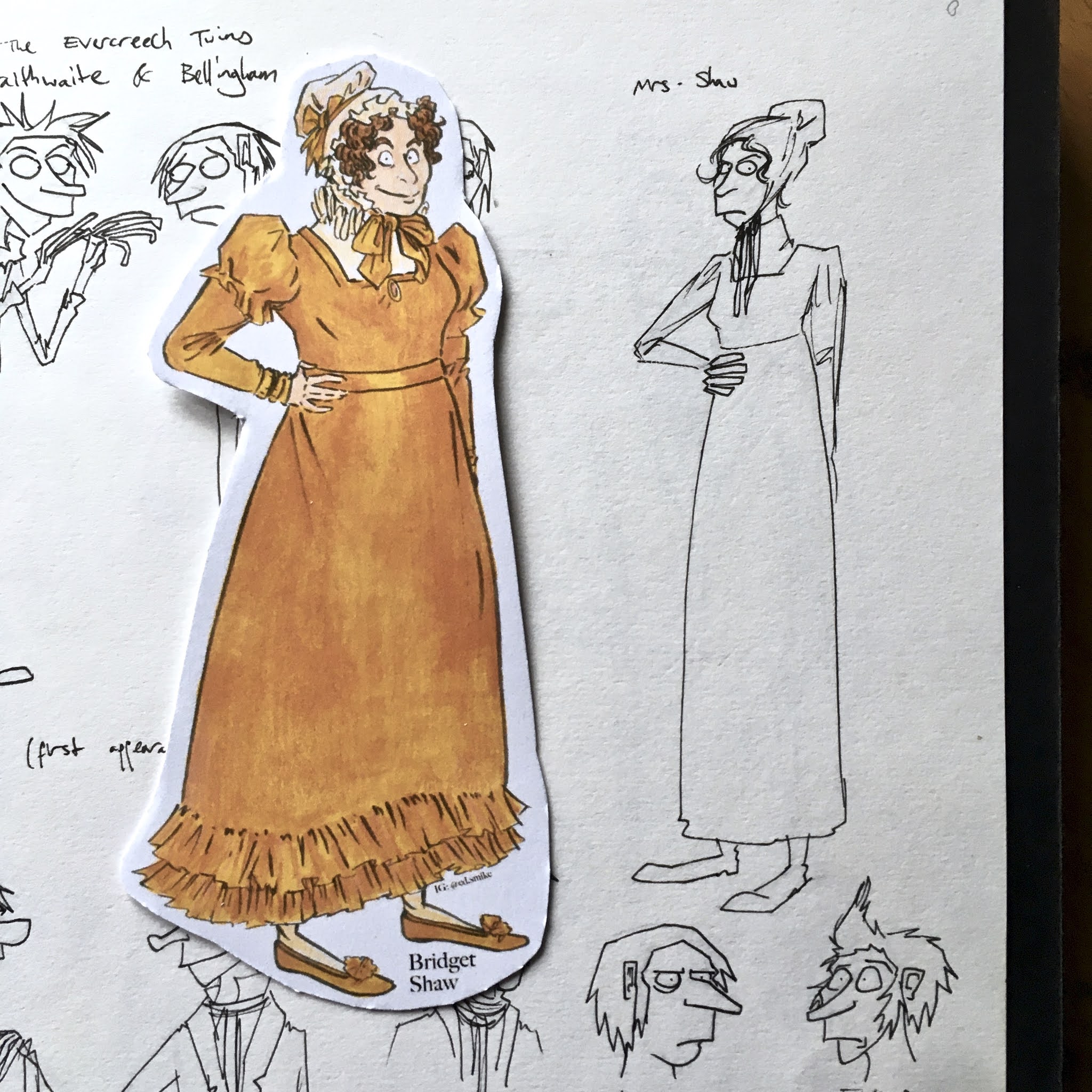
Bridget looks much happier now.

Bridget Shaw didn’t appear much in the graphic novel. When she did, she was only vaguely bothered about the boys’ welfare, but not too much - which contrasts with accounts of her behaviour that I later found, how concerned she was during the ophthalmia epidemic, how alarmed she was when one of the boys became ill suddenly, and an interesting rumour of how she interrupted beatings. 


Physically, my characterisation of her in 2014 was based on Mrs. Squeers, who I (at the time) thought must’ve been based on Bridget, but I don’t think that Dickens and Phiz ever saw her - so I’ve got free reign to design her as I see fit. (And, of course, I’d encourage anybody else to draw her according to their interpretation!) Now I want her to be a physical contrast to her husband, so while he’s skinny and sharp and somewhat restrained in his movements, Bridget is rather more substantially built (which, historiographically, is funny because there isn't much substantial evidence about her compared to her husband) and prone to effervescent mannerisms.


Here's Ann with one of my latest sketches of her.


So there they are - and I had so much fun making the new drawings, that I had to include Ann Mackay, who never appeared in my graphic novel, so I didn’t have to consider my previous interpretations when I started drawing her for my PhD project - because I didn't have any! (Which, in hindsight, is a bit silly, but then my attitudes towards research at that time were a bit silly anyway. It's good to learn stuff and get better at things.)


I'll do a post about Ann and Charley, and the influences and stuff I used to draw them.


Right - bookmarks! Free stuff! The PDF contains two sheets: one black-and-white (that you can colour according to your own inclinations, if you like) and one with the colours that I usually use for these characters.


This book is amazing and one day I will do a post in which I review it/ scream about how good it is/ make a lot of noise about the astonishing things it contains. It definitely contains William.

This is what's in the PDF!


I ended up going for a blue-ish theme when I coloured my black-and-white ones. Poor William looks like a ghost. Bridget's dress though. 👍


Here's the PDF. Print it out on decent A4 card, and get a responsible person to help with cutting them out. And show me if you do anything with them!


Thursday, December 10, 2020

Let's draw William Shaw

Alrighty, so in this post I’ll show you how to draw the ‘protagonist’, I suppose, of my case study. The methods I use here can also be used on other historical people. 

Rather than your standard how-to-draw-a-human tutorial (start with a vague skeleton, etc.) I'm going to show you how to get an idea of what somebody might've looked like, drawing from a load of historical sources. I'll include a few sources relating to William, so you can join in, and use him to practice on. How you interpret those sources is likely to be different to how anybody else does, so if you join in, don't worry if your version looks different to mine!

This is William Shaw. He was born around 1782, probably in London (although there’s suspicions that he may have had familial connections with the Teesdale area). He ended up running Bowes Academy from 1814 to 1840. In 1810, he married Bridget Laidman, who came from a local farming family, and they had nine kids together. William and Bridget are buried in the same plot in St. Giles’ churchyard, Bowes, together with their son William. (I tend to refer to the latter as Will to avoid confusion!)


So how do you draw this here schoolmaster?


Luckily for us - not so luckily for him - a couple of chaps called Charles Dickens and Hablot Knight ‘Phiz’ Browne took a bit of an interest in his school. 


Dickens had heard horror stories about cheap boarding schools in Yorkshire and wanted to write about them, and expose these horrors to the public, so he and his illustrator friend Phiz went up on a research trip. (Research in the loosest sense of the word.) Anyway, they went under false names, asked questions, heard stuff from people, and one thing led to another, and they got a good look at William Shaw - they went to visit his school, hoping for a look around.


This image is from a presentation I gave to my local history society in March 2020, right before the first UK lockdown.


However, William had heard there was an undercover journalist from London sniffing around the area and didn’t want anybody sniffing around him (he’d been taken to court in 1823 for neglect, and it’d been widely reported in the newspapers, and he didn’t want all that dragged up again) so when they knocked on his door, he sent them on their way. But they’d seen him - a short, somewhat unorthodox-looking chap, with one functioning eye - and that was enough for them.


William’s appearance turned up in the first instalment of Nicholas Nickleby, turned up to eleven and given the name Wackford Squeers. This was catastrophic for him and Bridget and the Academy - the parents in London recognised that there’s only one one-eyed schoolmaster in Yorkshire, and believed every word of Dickens' tales of woe…


Anyway! We’re here to draw William Shaw, aren’t we? Right! Let’s get cracking!


First, we’re going to look at Phiz’s first illustration of Wackford Squeers. Some of his ex-pupils, and even Phiz himself, said that this character strongly visually resembled William, but somewhat exaggerated. 


The Yorkshire Schoolmaster at The Saracen's Head which would've been part of the first instalment of Nicholas Nickleby. There's Mr. Squeers, pretending to mend a pen.


Here’s how I worked out what I think his face looked like: I drew Phiz’s version, then ‘translated’ him into my own visual language (drawing style), and then de-exaggerated him to get the result.


Since people have said that Wackford Squeers' appearance is an overexaggerated version of William Shaw's appearance, I de-exaggerated him to see what the original might have looked like. Perhaps. We'll never really know.


Next, we’re going to look at this quote from actor Horatio Lloyd. He attended Bowes Academy in the early 1820s, and grew up to become an actor. He said William was “a most worthy and kind-hearted, if somewhat peculiar, gentleman” and described the schoolmaster in his memoirs, published in the 1880s:


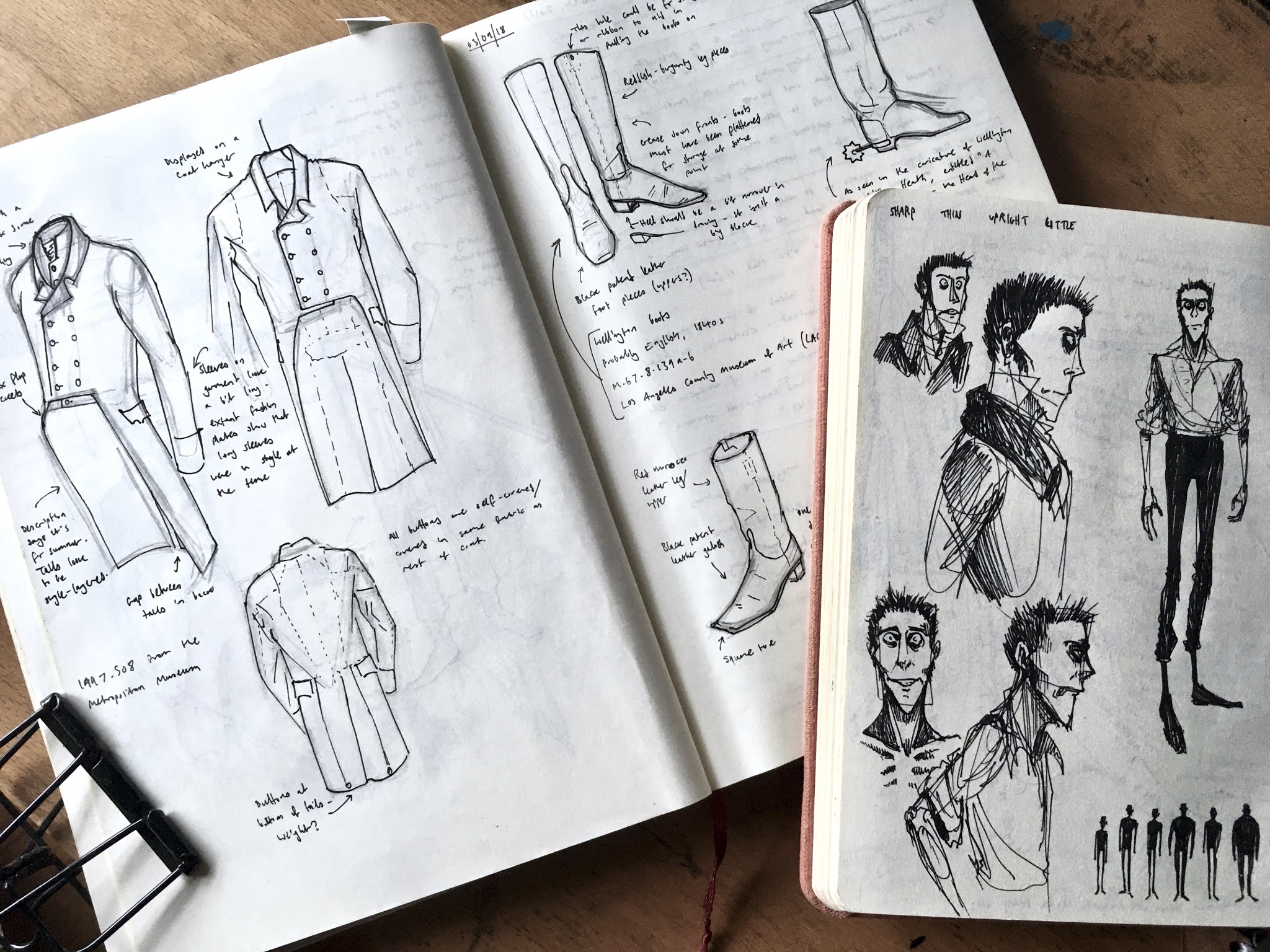
“A sharp, thin, upright little man, with a slight scale covering the pupil of one of the eyes. Yes. There he stands with his Wellington boots and short black trousers, not originally cut too short, but from a habit he had of sitting with one knee over the other, and the trousers being tight, they would get "ruck'd" half way up the boots. Then the clean white vest, swallow tailed black coat, white neck tie, silver-mounted spectacles, close cut iron-grey hair, high crowned hat worn slightly at the back of his head - and there you have the man.”


(Click here to read Lloyd’s account in full.) 


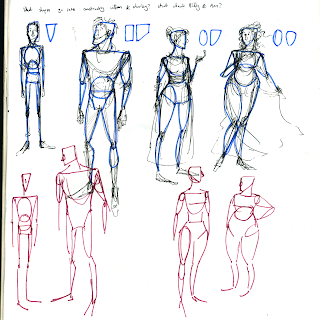
Lloyd has just given us a decent description of William’s clothing, along with one or two hints about his behaviour; he also mentions his dodgy eye, which indicates that Lloyd attended Bowes Academy following the ophthalmia fiasco. However, before we start on William's clothes, we need to think about his body - you need something to put the clothes on!


When I draw people in the wild, I automatically draw them in the costume of whatever time period I'm into - in this case, everybody gets Regencified.


As an illustrator, it’s a good idea to observe the people around you - under ordinary circumstances, I’d recommend going out onto the street and drawing people in the wild. They just go about their business and you draw them. But - we are not in normal circumstances! I’m writing this in the middle of a pandemic. You might need to get your refs elsewhere. Watch how people move on the telly, or check out Instagram for people doing cool poses and what-have-you.


Now we need to get references for his clothing. Get onto the online databases for museums! Check out re-enactors and historical costumers! Find contemporary images of people wearing similar stuff! Go window-shopping online or in books, whatevs, and try him out in different coats and such. 


Here’s three of my favourite museum sites to start you off:

Victoria & Albert Museum

Rijksmuseum (You can make an account on here that’s a bit like Pinterest in that you can make collections and save things that you find, and you know it’s all decent and properly checked because it’s the Rijksmuseum and it hasn’t been saved by randomers from across the internet.)

The Metropolitan Museum of Art


(Pro tip: when you’re drawing anything from museums, etc., keep note of item numbers, which museum it’s in, date of manufacture, artist’s names, etc. - this will save a few headaches when you want to have another look at a really good coat or something later, and you can’t remember where you found it.)


Alrighty, so you’ve got some more solid stuff: you’ve got an idea of his face, you’ve given him a body, and you’ve put clothes on him. Now what? Make him do things! And the great thing about drawing is that you can make him do anything! You are in control of the pencil, or pen, or whatever. What’s he going to do?


We could ask Lloyd first.


“[William Shaw] would walk around the school room, look over us while writing, and here and there pat a boy on the head, saying "good boy - good boy; you'll be a great man some day, if you pay attention to your lessons." If a lad was ill, he would sit by his bed-side and play the flute - on which he was an adept - for an hour or two together to amuse him.”


Sometimes I think Lloyd’s a bit rose-tinted in his remembering, and I don’t entirely trust him because he’s convinced that none other than Charles Dickens attended the Academy - which is a load of wack. Anyway, let’s have a look at some other stuff. 


Some lecturers. I can't remember exactly who, and the drawings don't have any identifying clues - I'm not interested in representing specific living individuals (partly because that could be ethically dodgy) - I'm more interested in how they move.

What if we think about our own experiences at school? How did the teachers move around the room? Did they stride about, or get excited about what’s on the board, or do alarming things with dictionaries? This might influence how you draw him in the schoolroom. Or find something like this writing-blank from 1810 that shows (idealised) schoolroom scenes of the time, or this hilarious print depicting classroom chaos from circa 1825!


What about when he’s elsewhere? When he goes to London to meet parents and new boys? When he’s at home with Bridget and the kids? When he nips into town to post a letter or buy some ink?


Here’s where I’m going to leave you. Go forth and find your own things that will inform your own drawings - and have fun with it! And, if you do draw William Shaw, or anybody else using this sort of thing, please show me! Head over to Instagram or Twitter to share whatever exciting things you draw.

Characterisation of Charley and Ann - or, Beauty and Sublimity

[Looks like I'd started writing this in 2021, and only now I am getting round to posting it. Hang about, we've got the word "su...