Showing posts with label project. Show all posts

Saturday, March 13, 2021

Disorder introduction illustration process

So, in this post, I'll show you how I made one of the illustrations for the introduction of Disorder. (It's my weird history-comic-thing, and it used to be called Despaired Of but I changed it because Disorder is more appropriate.)

I suppose this post is a vague indication of the work that goes into one drawing - and I've not even covered all the stages of it - haha, whoops! 


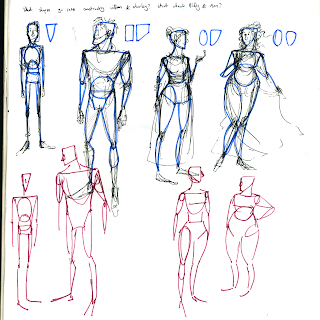
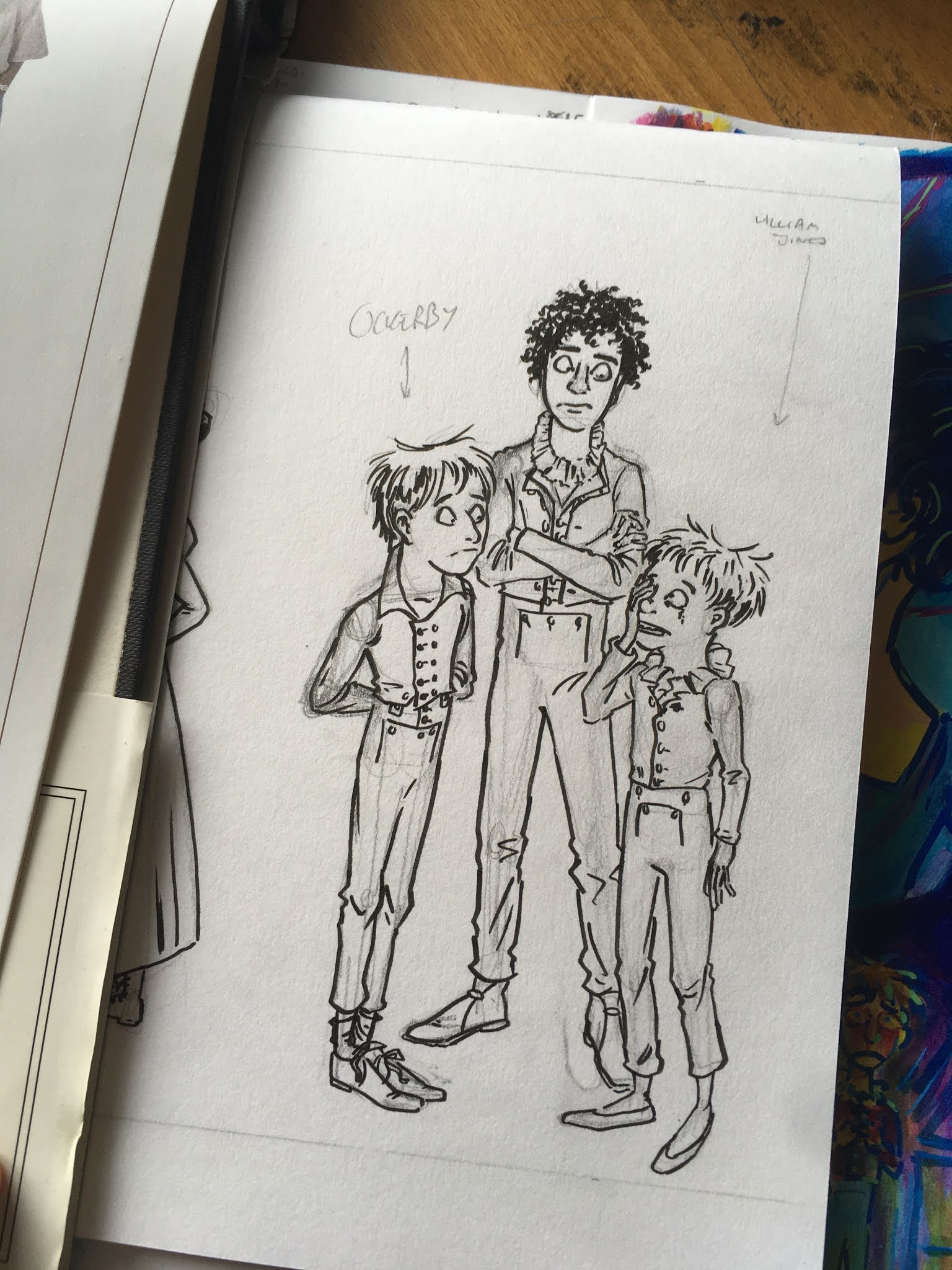
First off - actually, first is making preliminary drawings in my sketchbook - how I want to arrange the characters, what sort of gestures they might be doing, that sort of thing - but here's the initial pencil drawing that'll become the final illustration. I got a bit carried away and started inking. This gives an idea of how I structure people's limbs, etc., although sometimes my ideas change partway through a final. There's always chance to edit.


Refs! I wanted the three boys to be characters I've already drawn. One of them is Horatio Ockerby, and another is William Jones - two of the boys whose parents took schoolmaster William Shaw to court for neglect because the boys' sight was damaged in an ophthalmia outbreak at his school. I've already got drawings of these two, including final illustrations from a talk I gave to CDHAS (my local history society) right at the start of March 2020.

The clothing refs are from a number of sources, including extant garments and engravings and fashion plates and cartoons in various museums and galleries.


More refs - this is from a book in the Illustrator's Reference Manual series, published by Bloomsbury in 1990. 


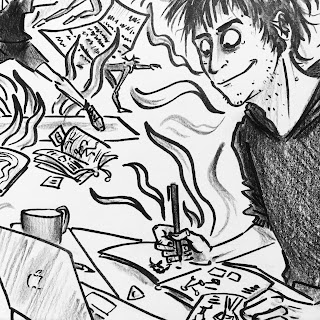
Another good reference - yourself! You can draw cool hands if you've got a camera (I use the built-in one on my laptop), and you can draw great hands with a bit of practice. Alternatively, go traditional and spend ages holding a pose in a mirror, or bribe whoever happens to be stuck in the house with you to hold poses for you. What wonderful lockdown memories you'll make together.

On my screen, you can also see one of the CDHAS talk illustrations, showing the Jones brothers giving evidence. We'll never know exactly what they looked like, but that's ok. These are my interpretations of them - and I'd like to encourage you to make your own interpretations of them, or of any other historical person!

The third boy already appears in a couple of pages of the comic - here he is, I've put big yellow circles round him. I want to establish continuity between the introduction and the comic itself, so using the same characters - that the reader can notice in the drawings - makes sense. Our lad here isn't based on a specific historical individual, like Horatio Ockerby and William Jones, so he doesn't have a name, but then we don't know the names of most of the people involved in the Yorkshire schools.


All inked! Now wait for it to dry, and rub out the pencil lines. If you look at the lower part of the image, you can see where I was going to put the tallest boy's left foot, but I decided to move it. In painting, this sort of thing is called a pentimento (no, you can't eat it) which is apparently a trace of an earlier image, or an earlier version of the present image, that's still there, but usually it's been painted over. It's evidence of the creator changing their mind during the process of making the image. 


Time to add colour! I think some of the population have ideas that sketchbooks are beautiful places where illustrators and other visual practitioners put all manner of eloquent delights, but they're actually working documents. (Some sketchbooks are deliberately designed to be stunners, though! But not mine.) 

I have a certain level of distrust for my media, and I've got to try it out and see what it actually comes out like before I commit to applying it to a drawing; there's less risk of wrecking the thing.

Also, keep notes on your colour choices - the amount of times I've drawn somebody once, and then had to draw them again later, and then I can't remember exactly which shade I've used for their coat or whatever - it saves time and headaches.

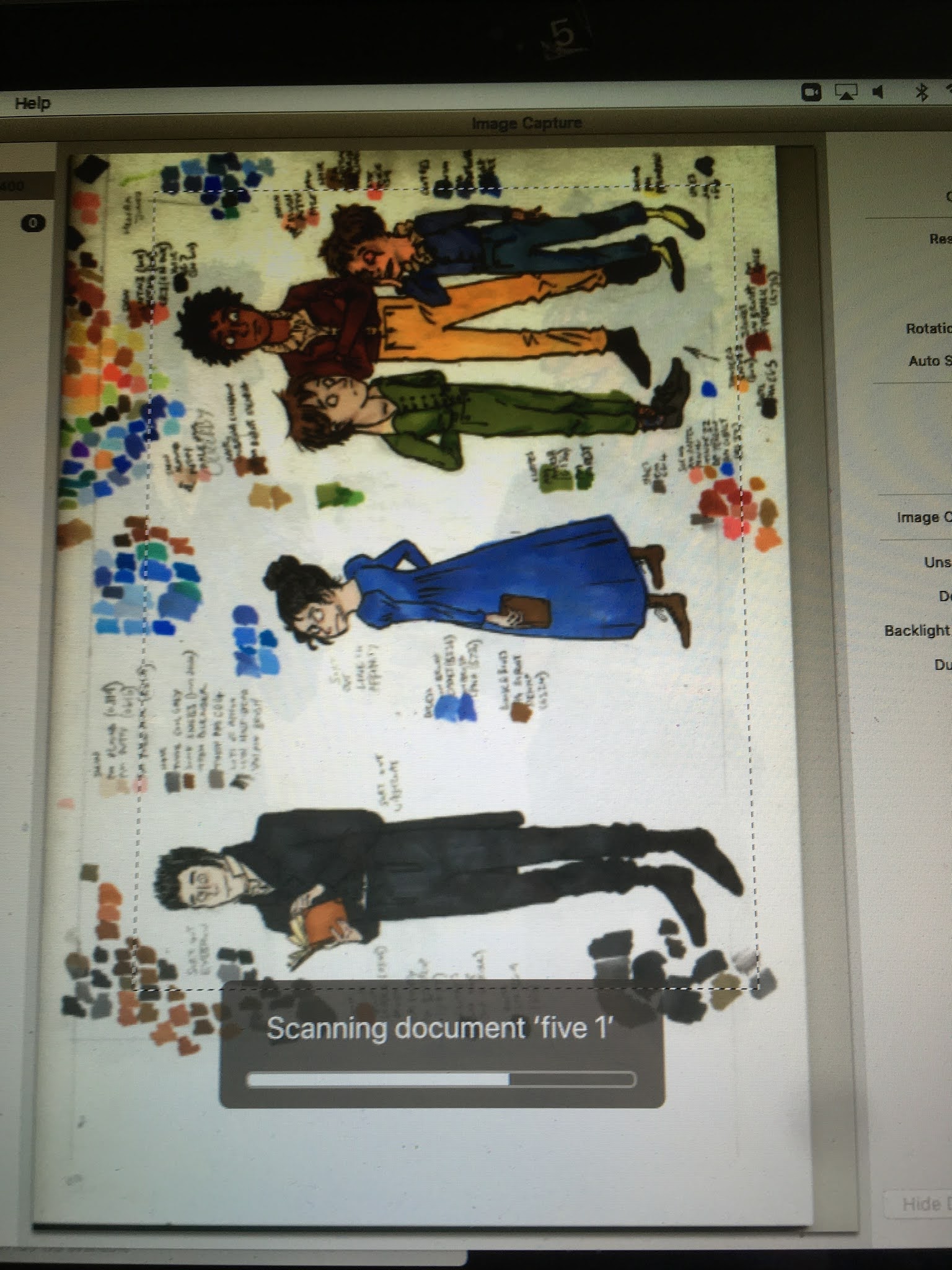
That's the colours done! Another thing - if you're using alcohol-based markers (like me), put a sheet of scrap paper under the sheet you're drawing on, or they'll bleed through onto your next page.


Time to scan! We've got William and Mary Ann Shaw on this page, too.


I do all my image editing for finals in Affinity Photo. Here I'm messing about with the levels to make the colours a bit snazzier. I'll need to tidy up the edges - much selecting, judicious use of the eraser, that sort of thing. I want this illustration to be a PNG file (it'll have a transparent background) which will allow me to arrange it to look cool in Pages.


Good tip - if you've cut your illustration out, and you want it to have a transparent background, it's useful to make a new layer behind your drawing, and fill it with some dark colour. The artefacts and other random pale bits round the edges will all appear as if by magic, and can be dealt with accordingly.
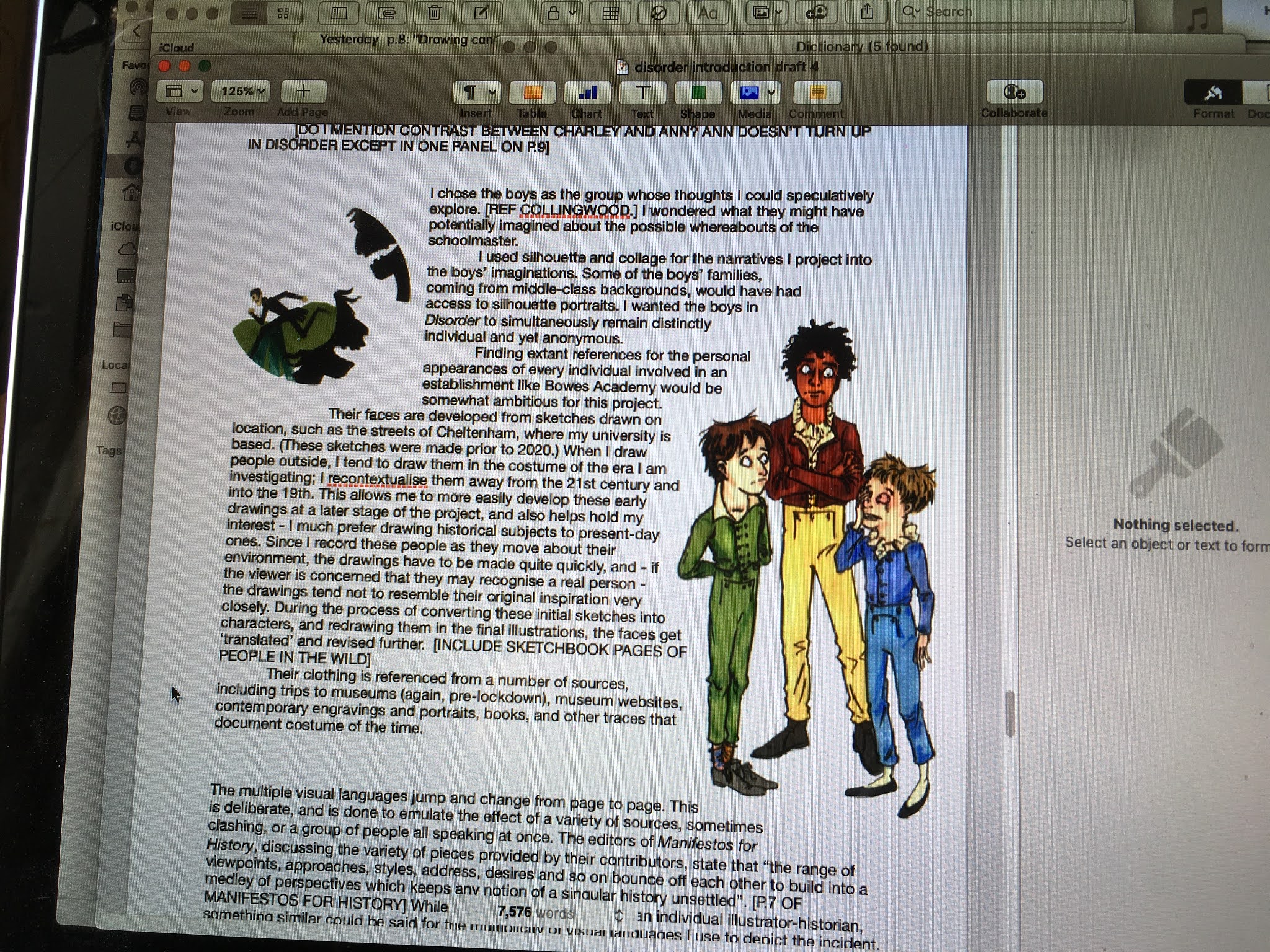


And here's how they'll look in the introduction! I'm on the fourth draft and the thing's nowhere near finished. The words are a work-in-progress. I like to shout in capitals when I need to remind myself to do something.

So that's that! For now. I really need to crack on with that introduction. It's going to be a tasty combination of drawings and words - a proper interdisciplinary piece - which will act as a warm-up to the main event: the comic itself.

Wednesday, November 25, 2020

Lines on a Page - watch the presentation and read the paper!

Alrighty, so I've managed to record the presentation for my paper, Lines on a Page: Representations and Interpretations! 

(It was originally meant for an internal online conference with the School of Art and the School of Media, but I had my appendix removed in the small hours of the day that the conference was scheduled for, so I couldn't actually attend...)


And here's links to the paper:

ResearchGate

Academia.edu

If you can't access it, DM me on Instagram - the most reliable way to contact me - and we'll sort something out.

(The paper is illustrated, if that's any further incentive to read the thing! But I'm an illustrator - what else would I do?)

Monday, November 9, 2020

About

I’m Ed, and I’m doing my PhD in Illustration with History at the University of Gloucestershire.

My project is titled Historical deconstruction and re-creation by narrative illustration, evoking the multiplicity of unheard narratives within historical experience.


Let’s unpack that:


Historical deconstruction: I’m a deconstructivist historian. As far as we’re concerned, there is no final single truth in history; there is no one story; there is no objectivity; there are multiple narratives, multiple truths, and multiple interpretations; the historian themself is central to the creation of meaning within history; and what’s left in the historical record (the ‘sources’/ traces of the past) will not tell you ‘the facts’.


Re-creation by narrative illustration: so I’m communicating stories by drawing. I’m not trying to accurately reconstruct the past, but to create my interpretations of it.


Evoking: like I just said, I’m not aiming for 100% accuracy. I’m aiming more to suggest stuff rather than state it definitively.


The multiplicity of narratives within historical experience: there is no one single narrative about any historical event because there’s usually a bunch of different people involved, and they’ll all have their own version. Of course, not all of these stories will have survived, so I’m using drawing to suggest what these stories of these people’s experiences might have been like.


My project is interdisciplinary (combining my two disciplines, Illustration and History) and practice-based (it’s based around my practice as an illustrator). I’m integrating illustration methods and strategies with historical practice and theory, and conducting drawing-based explorations into historiography. The project is also very reflexive - there’s a lot of stuff about my personal practice, and how I relate to the stuff I’m researching.


From a pamphlet about the project from 2019.


I’m using a specific historical case study for my investigations. This is William Shaw’s Bowes Academy, which he ran under sole ownership from 1814 until 1840. This was one of the Yorkshire schools - a group of boarding schools, mainly in Teesdale (then North Yorkshire, but now part of County Durham), which mostly ran from c. 1750 to c. 1850, and which typically aimed at middle-class parents in London.


Shaw’s Academy is the most well-documented of the Yorkshire schools, and operated when they were at their most popular. It was also pretty big - at one point, there were between 260 to 300 boys present. 


I’m mainly interested in the social relations of people at the Academy. I’m looking at William Shaw and his family, members of staff (both in the school and domestic), and the boys themselves; I’m also expanding my investigation to look further afield, such as William’s social connections and the parents in London and elsewhere.


What do I hope to do with all this? I want to revolutionise the discipline of history. Haha! That sounds big. I want to help open it up for people whose first mode of communication isn’t necessarily based around writing. I want to encourage people to explore the vast potential of lost narratives within historical experience. I want to see other researchers, further down the line, take some of my methods and apply those to their own work, generating a broader understanding of their own disciplines and the narratives contained (or hidden or excluded) therein.


Also, I want to conduct the deepest investigation of Shaw’s Academy to date. I want to get into areas that other researchers have not considered, and to dig stuff up and make suggestions that make people think twice. (Right now I’m thinking a lot about plausibility, and making an audience act like historians and question and interpret everything.)


And what about me? I got my BA and MA in Illustration at the University of Gloucestershire in 2015 and 2017 respectively. I’ve done a couple of commercial jobs here and there, but I want to show that illustrators can do research too, and we don’t have to go into the industry. I no longer do commissions.


In my spare time, I do further research, and more drawings, and a bit of writing, and I’m a member of my local fitness group and the local history society. (All meetings now conducted online.)


Anyway, that’s your introduction. I’m going to use this blog - when I remember - to show stuff from my project, and probably some extra stuff too. Sketchbooks, work in progress, secret things, excursions (within reason), that sort of business.


I'm fairly active on Instagram - follow me: @Ed.smike


But I'm only sporadically active on Twitter: @Ed_smike

Characterisation of Charley and Ann - or, Beauty and Sublimity

[Looks like I'd started writing this in 2021, and only now I am getting round to posting it. Hang about, we've got the word "su...