Showing posts with label drawing. Show all posts

Friday, May 14, 2021

Exciting news about Mary Ann Shaw and Emily Shaw

We don’t often hear stories about women involved in the Yorkshire schools, so here’s some things I’ve found relating to two of William and Bridget Shaw’s daughters! Yes, it’s news about them from after the main bit of my case study (my project title specifies 1814 - 1840) but it’s exciting anyway.


News about Mary Ann!


Mary Ann Shaw was William and Bridget’s oldest child, born on 8th September 1811, according to the excellent and useful Laidman one-name study site. She was baptised on 21st September 1811.


I have strong reason to suspect that she had some responsibility in the school and was involved in supervising the boys. There’s a letter from her dad to Mr and Mrs Brooks, the parents of a very ill boy, in which William says “my daughter observed him sitting up in bed” - this is from February 1826, when Mary Ann would have been 14. (What about her sisters? Wouldn’t they have been old enough? No, they wouldn’t - and that’s involved with the next bit of news. You’ll have to wait.) There’s also an account given by Robert Lamb, allegedly the son of a maid at Bowes Academy, and nephew of a local coachman - Lamb says that the pupils at the Academy were “properly looked after by Mrs Shaw or Miss Shaw”. (Get all this information and more in my favourite book, Charles Dickens, Nicholas Nickleby and the Yorkshire Schools: Fact v Fiction by Robert J. Kirkpatrick, published by Mosaic (Teesdale) Ltd., in 2017.)


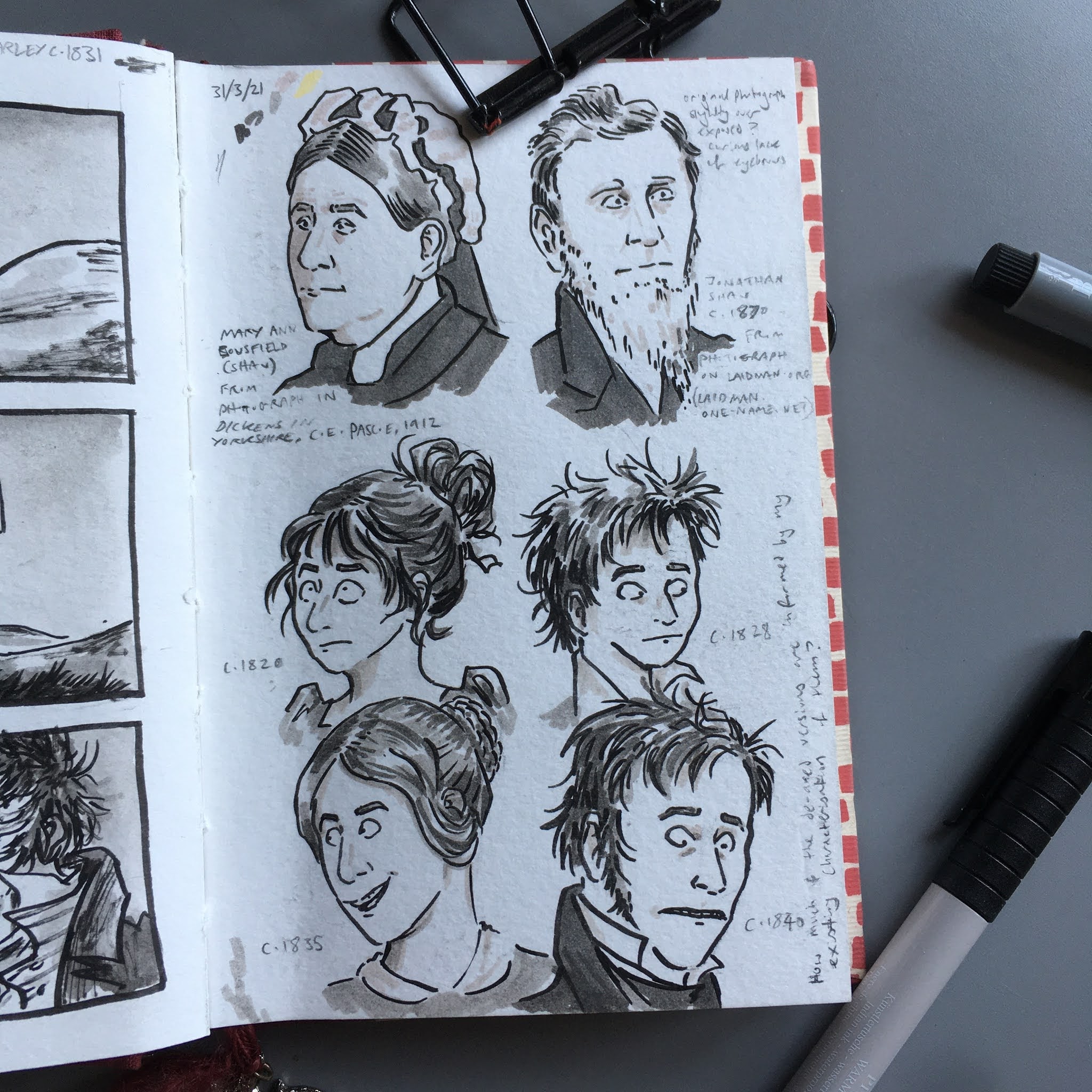
And here’s the really exciting bit: I’ve found a photograph of Mary Ann Shaw.


Alright, she wasn’t called Mary Ann Shaw at the time the photograph was taken - she was Mary Ann Bousfield by then. She married a local chap, John Bousfield, after William’s death, and they occupied her parents’ house. Apparently they neglected the old schoolroom and allowed it go to ruin.


Anyway, here’s how I found her. The Bowes Museum has a copy of a book called Dickens in Yorkshire by C. Eyre Pascoe, published 1912, so I tracked down a copy for myself. The author goes up to Teesdale and goes to places where Dickens went, interviews local people, and generally sees the sights. He doesn’t explicitly refer to the Shaw family by name, although, after much beating around the bush, he remarks (very hedgingly) that “Local tradition says that Wackford Squeers was one “Dr. Shaw.” It is so recorded in guide-book literature to the present day.”


Pascoe doesn’t seem too fond of William, but he is extremely fond of Mary Ann and Bridget, and Mary Ann's daughter. He refers to Mary Ann herself as “Miss Fanny Squeers”, going by the reckoning that, if Wackford Squeers = William Shaw, then Fanny Squeers = Mary Ann Shaw. Here’s what Pascoe says on pp.28-29:


“If I met one person I met half-a-dozen who assured me, that Miss Fanny Squeers, in propriety persona actually lived at Dotheboys Hall, and married a gentleman of the neighbourhood. I was shown that lady’s portrait - the pleasing portrait of a dignified-looking lady of middle age - and (as it were) asked to accept that as the “counterfeit presentment” of Dickens’s own Fanny Squeers.”


And then turn the page - and there she is!


Delight! Wonder! Marvellous discovery! Here is the face of a woman who had, in her youth, been involved in the running of a Yorkshire boarding school.


(Meanwhile, Pascoe is having delight and wonder of his own, as he declares that if he’d have been born earlier and in the right location, he’d have wanted to marry her. Bit awkward. Gets more awkward when he sees a photograph of her daughter and wants to marry her, too. Oh dear.)


The main implications for my work mean I’ve got to redesign Mary Ann a bit, but that won’t be a problem. 


De-aging Mary Ann - and her brother, Jonathan, whose photographs are on the Laidman site: here he is on his own c. 1870 - and here he is with his family, c. 1874 - and here is another version of the c. 1874 family photo. 


News about Emily!


Alrighty! The Laidman site says that Emily was born on 9th March 1825, and baptised on 19th March 1825. She married a chap called Frederick White, and they had a son, also called Frederick White - and that’s all we have.


Or is it?


I’m currently working on the introduction and conclusion to my weird graphic history-comic-experiment, Disorder. There’s a bit about Mary Ann, and how the unnamed daughter in her dad’s letter to Mr and Mrs Brooks could only have been Mary Ann due to the dates. Her sisters Jane (1822 - 1914) and Emily (1825 - ????) would have been too young to be involved in looking after the boys in 1826. 


That set of question marks in Emily’s dates vexed me. Laidman.org had given me a couple of dates and a couple of names, so I went dashing off to FamilySearch to see if I could dig them up. Lo and behold, I got her marriage record and, also quite exciting, a mention of her and Frederick getting married in the Newcastle Courant, in which she’s described as the “youngest daughter of the late William Shaw, Esq., of Bowes”.


I tracked the couple through the censuses - in 1861, they’re living in Lambeth. Oddly, it looks like they’re going as Mr and Mrs Waite rather than White, but that could be a transcribing error or something. Emily’s husband Frederick is the manager of a bottle warehouse, and they’re living with their kids Emily and Frederick, a servant called Anne Cockling, and an ex-governess called Elizabeth Mary White. The listing on FamilySearch gets a bit weird here because it says that Frederick (aged 39) is the head of the household, but Elizabeth Mary (aged 52) is his daughter. Could be another transcribing error or something. Might be worth looking at the actual census documents to try working out what’s going on here. 


In 1871, they’re at Marylebone (via Camberwell and Brixton, if you look at where their kids were born) with offspring Emily J., Frederick, and George N., and Ann Gulley, a servant. In 1881, they’re living in Battersea, but now the household is just Emily, her husband Frederick (who is now an accountant), and their son George H., who is a bank clerk. 1891 is the last census that they both appear in: still at Battersea, now living with their son Frederick (another bank clerk), and servant Anna Cox. They’re given the surname Waite again. 


Next step: Find A Grave! And find a grave is exactly what I did - I found Emily White, who was born on 9th March 1825 (matches up with Emily Shaw), who was married to Frederick White (another match), and who had a son called Frederick White (another match). Emily died on 19th December 1897 at Clapham, in the London borough of Lambeth, aged 72, and she’s buried at West Norwood, also in Lambeth.


Mary Ann reads to her sister Emily, c. 1830.


So yeah! Here is the news, regarding people who died in the nineteenth century. My favourite type of news. As usual, if you have access to drawing implements and a suitable surface, and you fancy making your own characterisations, I'll encourage you to do it!

Saturday, March 13, 2021

Disorder introduction illustration process

So, in this post, I'll show you how I made one of the illustrations for the introduction of Disorder. (It's my weird history-comic-thing, and it used to be called Despaired Of but I changed it because Disorder is more appropriate.)

I suppose this post is a vague indication of the work that goes into one drawing - and I've not even covered all the stages of it - haha, whoops! 


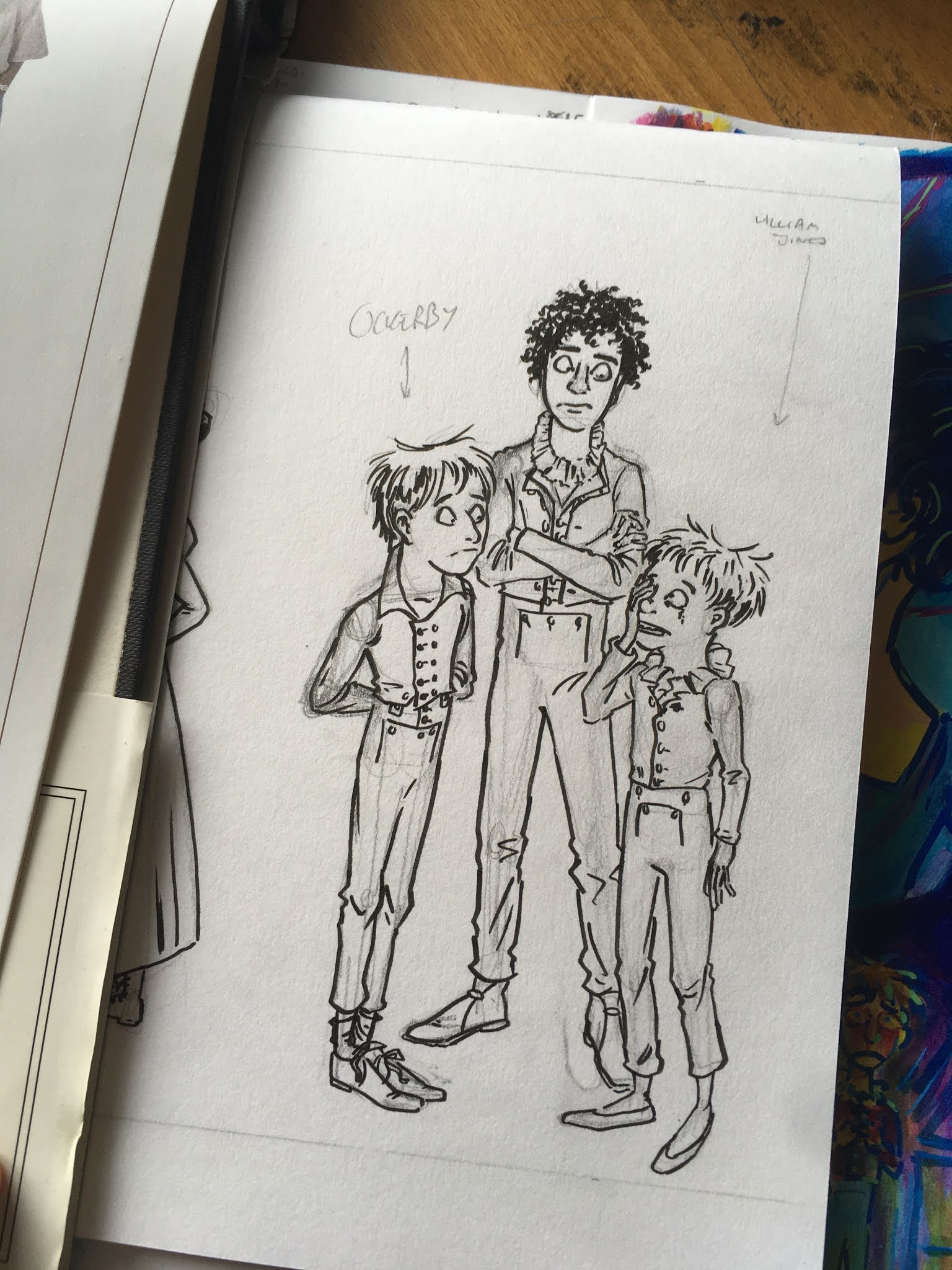
First off - actually, first is making preliminary drawings in my sketchbook - how I want to arrange the characters, what sort of gestures they might be doing, that sort of thing - but here's the initial pencil drawing that'll become the final illustration. I got a bit carried away and started inking. This gives an idea of how I structure people's limbs, etc., although sometimes my ideas change partway through a final. There's always chance to edit.


Refs! I wanted the three boys to be characters I've already drawn. One of them is Horatio Ockerby, and another is William Jones - two of the boys whose parents took schoolmaster William Shaw to court for neglect because the boys' sight was damaged in an ophthalmia outbreak at his school. I've already got drawings of these two, including final illustrations from a talk I gave to CDHAS (my local history society) right at the start of March 2020.

The clothing refs are from a number of sources, including extant garments and engravings and fashion plates and cartoons in various museums and galleries.


More refs - this is from a book in the Illustrator's Reference Manual series, published by Bloomsbury in 1990. 


Another good reference - yourself! You can draw cool hands if you've got a camera (I use the built-in one on my laptop), and you can draw great hands with a bit of practice. Alternatively, go traditional and spend ages holding a pose in a mirror, or bribe whoever happens to be stuck in the house with you to hold poses for you. What wonderful lockdown memories you'll make together.

On my screen, you can also see one of the CDHAS talk illustrations, showing the Jones brothers giving evidence. We'll never know exactly what they looked like, but that's ok. These are my interpretations of them - and I'd like to encourage you to make your own interpretations of them, or of any other historical person!


The third boy already appears in a couple of pages of the comic - here he is, I've put big yellow circles round him. I want to establish continuity between the introduction and the comic itself, so using the same characters - that the reader can notice in the drawings - makes sense. Our lad here isn't based on a specific historical individual, like Horatio Ockerby and William Jones, so he doesn't have a name, but then we don't know the names of most of the people involved in the Yorkshire schools.


All inked! Now wait for it to dry, and rub out the pencil lines. If you look at the lower part of the image, you can see where I was going to put the tallest boy's left foot, but I decided to move it. In painting, this sort of thing is called a pentimento (no, you can't eat it) which is apparently a trace of an earlier image, or an earlier version of the present image, that's still there, but usually it's been painted over. It's evidence of the creator changing their mind during the process of making the image. 


Time to add colour! I think some of the population have ideas that sketchbooks are beautiful places where illustrators and other visual practitioners put all manner of eloquent delights, but they're actually working documents. (Some sketchbooks are deliberately designed to be stunners, though! But not mine.) 

I have a certain level of distrust for my media, and I've got to try it out and see what it actually comes out like before I commit to applying it to a drawing; there's less risk of wrecking the thing.

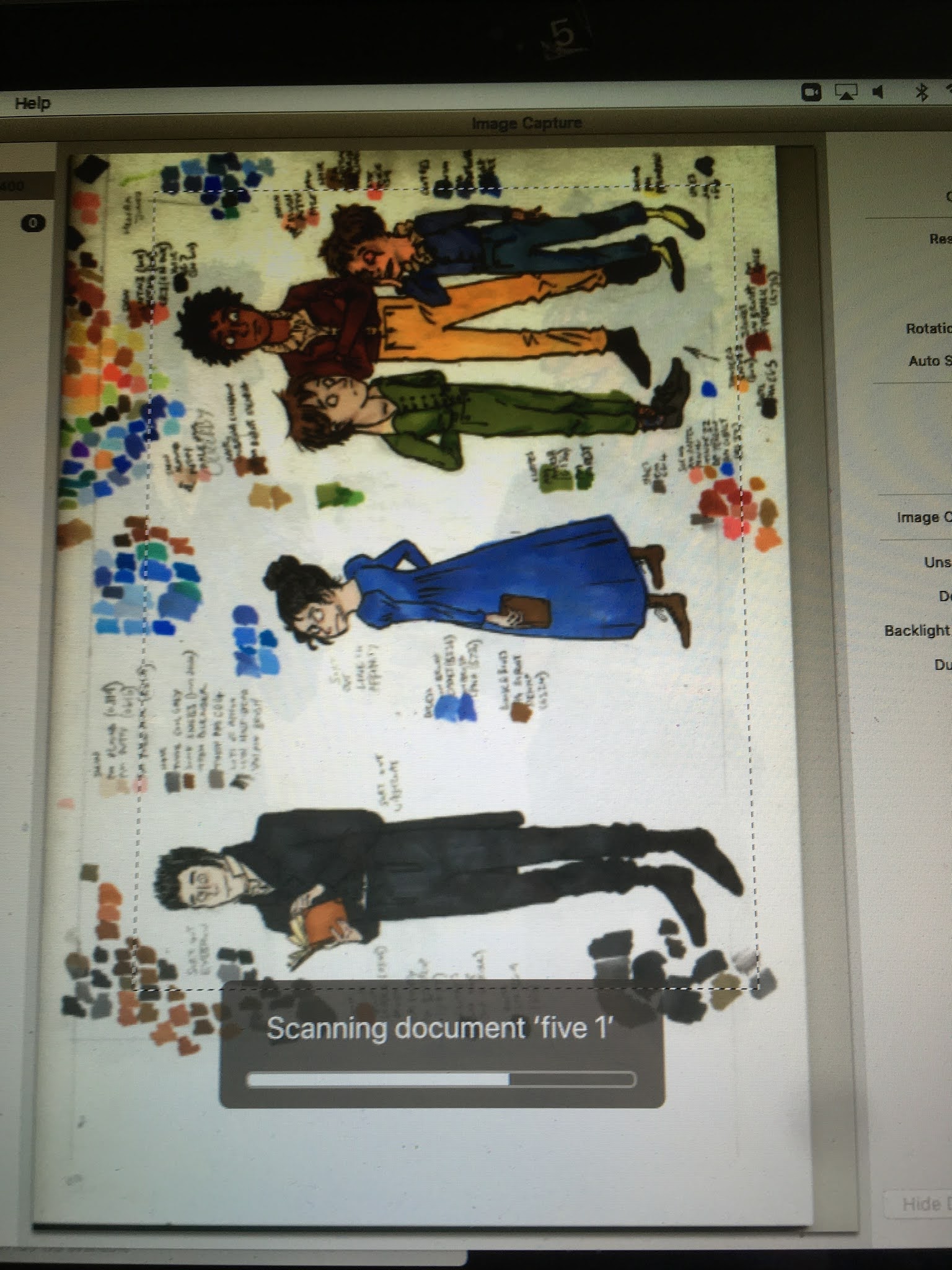
Also, keep notes on your colour choices - the amount of times I've drawn somebody once, and then had to draw them again later, and then I can't remember exactly which shade I've used for their coat or whatever - it saves time and headaches.


That's the colours done! Another thing - if you're using alcohol-based markers (like me), put a sheet of scrap paper under the sheet you're drawing on, or they'll bleed through onto your next page.


Time to scan! We've got William and Mary Ann Shaw on this page, too.


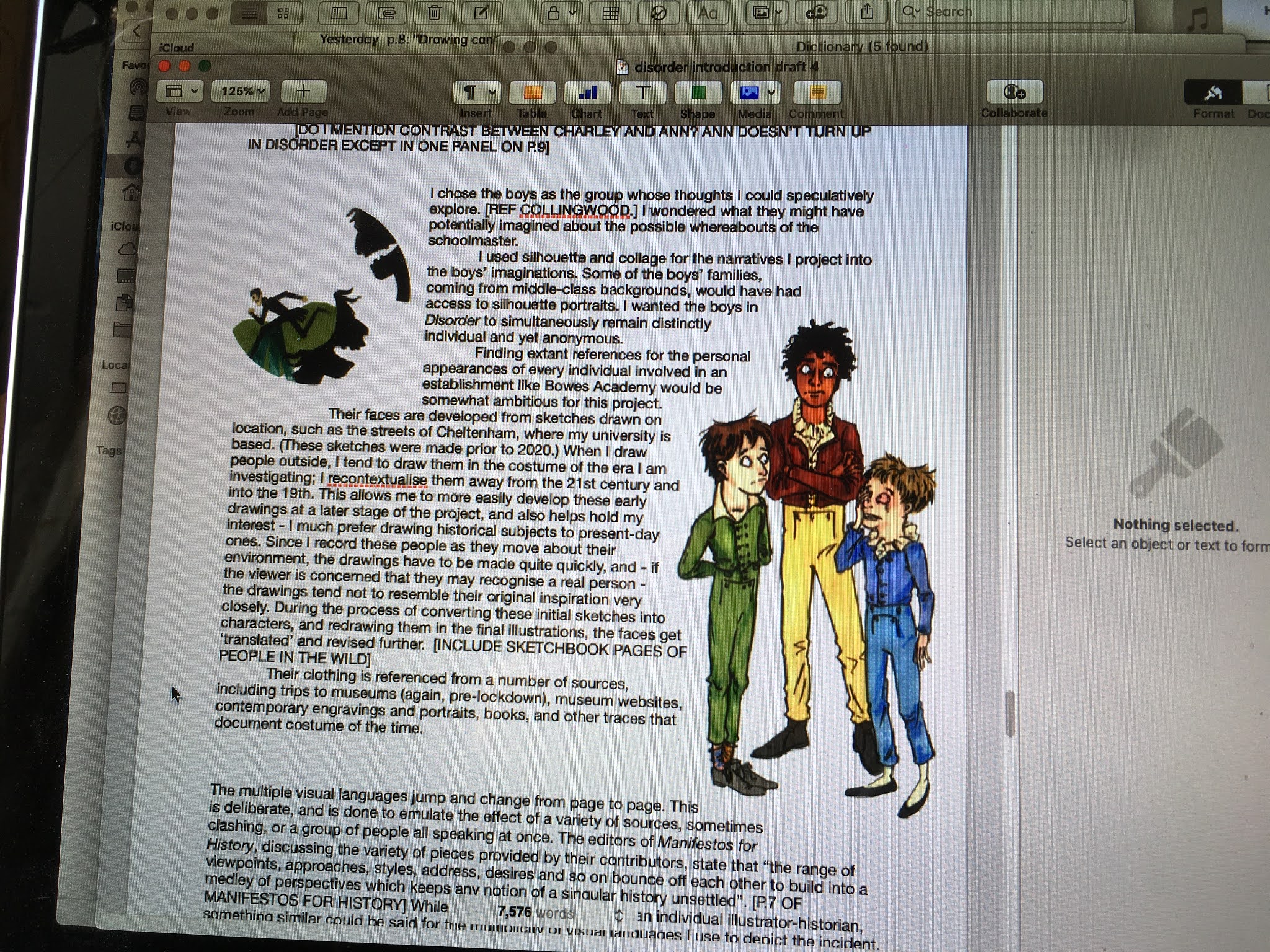
I do all my image editing for finals in Affinity Photo. Here I'm messing about with the levels to make the colours a bit snazzier. I'll need to tidy up the edges - much selecting, judicious use of the eraser, that sort of thing. I want this illustration to be a PNG file (it'll have a transparent background) which will allow me to arrange it to look cool in Pages.


Good tip - if you've cut your illustration out, and you want it to have a transparent background, it's useful to make a new layer behind your drawing, and fill it with some dark colour. The artefacts and other random pale bits round the edges will all appear as if by magic, and can be dealt with accordingly.


And here's how they'll look in the introduction! I'm on the fourth draft and the thing's nowhere near finished. The words are a work-in-progress. I like to shout in capitals when I need to remind myself to do something.

So that's that! For now. I really need to crack on with that introduction. It's going to be a tasty combination of drawings and words - a proper interdisciplinary piece - which will act as a warm-up to the main event: the comic itself.

Thursday, December 10, 2020

Let's draw William Shaw

Alrighty, so in this post I’ll show you how to draw the ‘protagonist’, I suppose, of my case study. The methods I use here can also be used on other historical people. 

Rather than your standard how-to-draw-a-human tutorial (start with a vague skeleton, etc.) I'm going to show you how to get an idea of what somebody might've looked like, drawing from a load of historical sources. I'll include a few sources relating to William, so you can join in, and use him to practice on. How you interpret those sources is likely to be different to how anybody else does, so if you join in, don't worry if your version looks different to mine!

This is William Shaw. He was born around 1782, probably in London (although there’s suspicions that he may have had familial connections with the Teesdale area). He ended up running Bowes Academy from 1814 to 1840. In 1810, he married Bridget Laidman, who came from a local farming family, and they had nine kids together. William and Bridget are buried in the same plot in St. Giles’ churchyard, Bowes, together with their son William. (I tend to refer to the latter as Will to avoid confusion!)


So how do you draw this here schoolmaster?


Luckily for us - not so luckily for him - a couple of chaps called Charles Dickens and Hablot Knight ‘Phiz’ Browne took a bit of an interest in his school. 


Dickens had heard horror stories about cheap boarding schools in Yorkshire and wanted to write about them, and expose these horrors to the public, so he and his illustrator friend Phiz went up on a research trip. (Research in the loosest sense of the word.) Anyway, they went under false names, asked questions, heard stuff from people, and one thing led to another, and they got a good look at William Shaw - they went to visit his school, hoping for a look around.


This image is from a presentation I gave to my local history society in March 2020, right before the first UK lockdown.


However, William had heard there was an undercover journalist from London sniffing around the area and didn’t want anybody sniffing around him (he’d been taken to court in 1823 for neglect, and it’d been widely reported in the newspapers, and he didn’t want all that dragged up again) so when they knocked on his door, he sent them on their way. But they’d seen him - a short, somewhat unorthodox-looking chap, with one functioning eye - and that was enough for them.


William’s appearance turned up in the first instalment of Nicholas Nickleby, turned up to eleven and given the name Wackford Squeers. This was catastrophic for him and Bridget and the Academy - the parents in London recognised that there’s only one one-eyed schoolmaster in Yorkshire, and believed every word of Dickens' tales of woe…


Anyway! We’re here to draw William Shaw, aren’t we? Right! Let’s get cracking!


First, we’re going to look at Phiz’s first illustration of Wackford Squeers. Some of his ex-pupils, and even Phiz himself, said that this character strongly visually resembled William, but somewhat exaggerated. 


The Yorkshire Schoolmaster at The Saracen's Head which would've been part of the first instalment of Nicholas Nickleby. There's Mr. Squeers, pretending to mend a pen.


Here’s how I worked out what I think his face looked like: I drew Phiz’s version, then ‘translated’ him into my own visual language (drawing style), and then de-exaggerated him to get the result.


Since people have said that Wackford Squeers' appearance is an overexaggerated version of William Shaw's appearance, I de-exaggerated him to see what the original might have looked like. Perhaps. We'll never really know.


Next, we’re going to look at this quote from actor Horatio Lloyd. He attended Bowes Academy in the early 1820s, and grew up to become an actor. He said William was “a most worthy and kind-hearted, if somewhat peculiar, gentleman” and described the schoolmaster in his memoirs, published in the 1880s:


“A sharp, thin, upright little man, with a slight scale covering the pupil of one of the eyes. Yes. There he stands with his Wellington boots and short black trousers, not originally cut too short, but from a habit he had of sitting with one knee over the other, and the trousers being tight, they would get "ruck'd" half way up the boots. Then the clean white vest, swallow tailed black coat, white neck tie, silver-mounted spectacles, close cut iron-grey hair, high crowned hat worn slightly at the back of his head - and there you have the man.”


(Click here to read Lloyd’s account in full.


Lloyd has just given us a decent description of William’s clothing, along with one or two hints about his behaviour; he also mentions his dodgy eye, which indicates that Lloyd attended Bowes Academy following the ophthalmia fiasco. However, before we start on William's clothes, we need to think about his body - you need something to put the clothes on!


When I draw people in the wild, I automatically draw them in the costume of whatever time period I'm into - in this case, everybody gets Regencified.


As an illustrator, it’s a good idea to observe the people around you - under ordinary circumstances, I’d recommend going out onto the street and drawing people in the wild. They just go about their business and you draw them. But - we are not in normal circumstances! I’m writing this in the middle of a pandemic. You might need to get your refs elsewhere. Watch how people move on the telly, or check out Instagram for people doing cool poses and what-have-you.


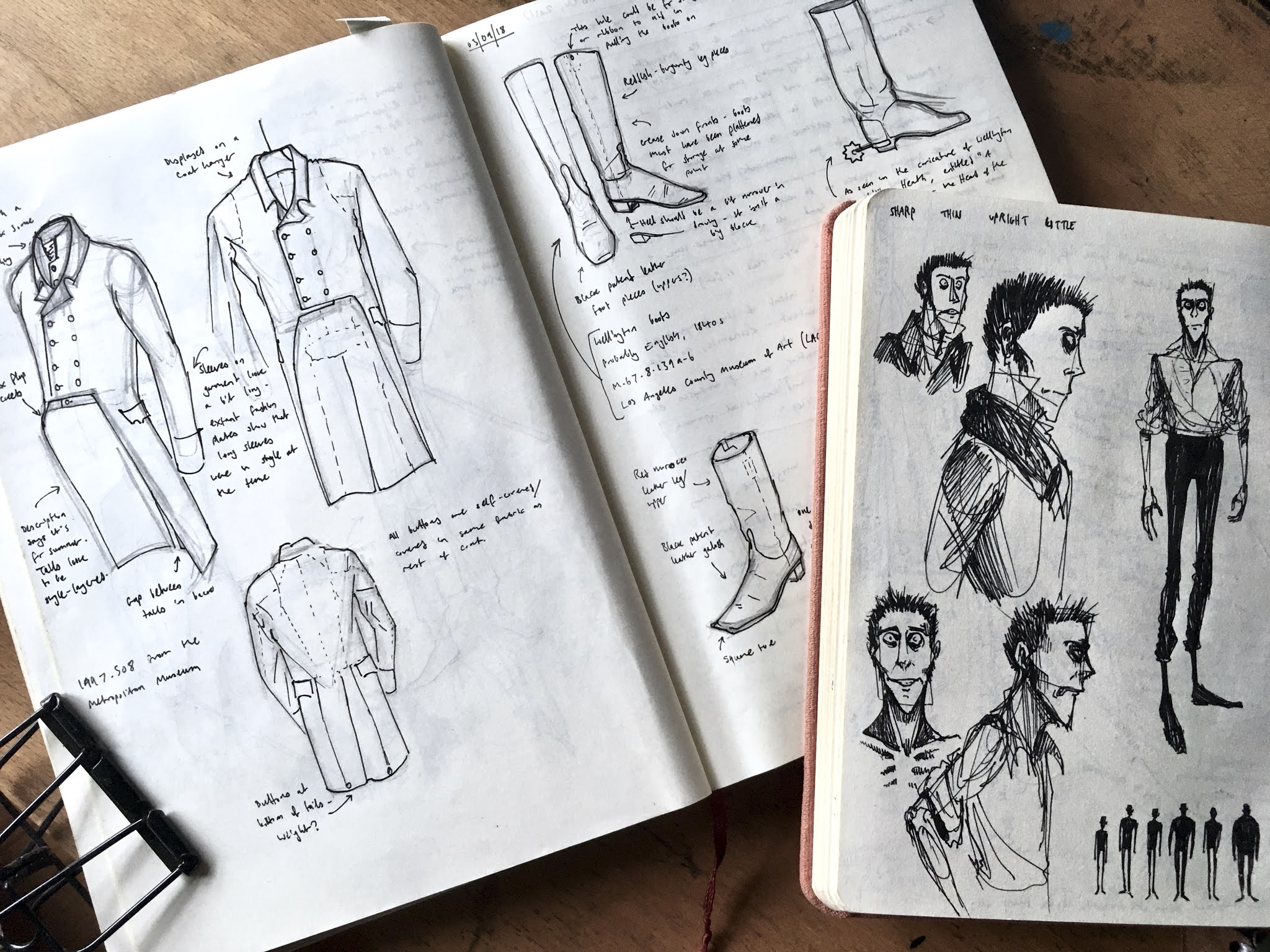
Now we need to get references for his clothing. Get onto the online databases for museums! Check out re-enactors and historical costumers! Find contemporary images of people wearing similar stuff! Go window-shopping online or in books, whatevs, and try him out in different coats and such. 


Here’s three of my favourite museum sites to start you off:

Victoria & Albert Museum

Rijksmuseum (You can make an account on here that’s a bit like Pinterest in that you can make collections and save things that you find, and you know it’s all decent and properly checked because it’s the Rijksmuseum and it hasn’t been saved by randomers from across the internet.)

The Metropolitan Museum of Art


(Pro tip: when you’re drawing anything from museums, etc., keep note of item numbers, which museum it’s in, date of manufacture, artist’s names, etc. - this will save a few headaches when you want to have another look at a really good coat or something later, and you can’t remember where you found it.)


Alrighty, so you’ve got some more solid stuff: you’ve got an idea of his face, you’ve given him a body, and you’ve put clothes on him. Now what? Make him do things! And the great thing about drawing is that you can make him do anything! You are in control of the pencil, or pen, or whatever. What’s he going to do?


We could ask Lloyd first.


“[William Shaw] would walk around the school room, look over us while writing, and here and there pat a boy on the head, saying "good boy - good boy; you'll be a great man some day, if you pay attention to your lessons." If a lad was ill, he would sit by his bed-side and play the flute - on which he was an adept - for an hour or two together to amuse him.”


Sometimes I think Lloyd’s a bit rose-tinted in his remembering, and I don’t entirely trust him because he’s convinced that none other than Charles Dickens attended the Academy - which is a load of wack. Anyway, let’s have a look at some other stuff. 


Some lecturers. I can't remember exactly who, and the drawings don't have any identifying clues - I'm not interested in representing specific living individuals (partly because that could be ethically dodgy) - I'm more interested in how they move.

What if we think about our own experiences at school? How did the teachers move around the room? Did they stride about, or get excited about what’s on the board, or do alarming things with dictionaries? This might influence how you draw him in the schoolroom. Or find something like this writing-blank from 1810 that shows (idealised) schoolroom scenes of the time, or this hilarious print depicting classroom chaos from circa 1825!


What about when he’s elsewhere? When he goes to London to meet parents and new boys? When he’s at home with Bridget and the kids? When he nips into town to post a letter or buy some ink?


Here’s where I’m going to leave you. Go forth and find your own things that will inform your own drawings - and have fun with it! And, if you do draw William Shaw, or anybody else using this sort of thing, please show me! Head over to Instagram or Twitter to share whatever exciting things you draw.

Wednesday, November 25, 2020

Lines on a Page - watch the presentation and read the paper!

Alrighty, so I've managed to record the presentation for my paper, Lines on a Page: Representations and Interpretations! 

(It was originally meant for an internal online conference with the School of Art and the School of Media, but I had my appendix removed in the small hours of the day that the conference was scheduled for, so I couldn't actually attend...)


And here's links to the paper:

ResearchGate

Academia.edu

If you can't access it, DM me on Instagram - the most reliable way to contact me - and we'll sort something out.

(The paper is illustrated, if that's any further incentive to read the thing! But I'm an illustrator - what else would I do?)

Characterisation of Charley and Ann - or, Beauty and Sublimity

[Looks like I'd started writing this in 2021, and only now I am getting round to posting it. Hang about, we've got the word "su...