Showing posts with label Charles Dickens. Show all posts

Friday, August 4, 2023

PhD sketchbooks: A4BF (September 2021 - ongoing)

Which is mostly finals for the definitions (photos of the prototype product at the end of this post) and (U)KA! (Timelapse video here!)

Furious about disembodiment again

Diagrams, trying to make sense of themes and such in my entire project, for the purposes of sorting out the thesis

Experiments done while looking at Remedios Varo's work

Left hand page: apparently the building that had been Bowes Academy later became a cafe. Right hand page: more Varo-esque stuff, that being the death (and ascension) of Mr Dixon for (U)KA, and Charley with too many mouths as an alarming metaphor for multiple voices/ stories and not finding the information you want where you expect. Preliminary versions in IBK.

Thinking about the Perception (which also appears in SBF) and which will be a postdoctoral project (comic? who knows) about how the discipline and practitioners of history are perceived, and what we're expected to do and to be like. 

Left: keeping track of which (U)KA cards I'd digitally processed (which got glued in much later). Right: things for the definitions, based on definitions for Dinsdale's Teesdale Glossary (see IBJ) and further pushing the idea in IBL with Barclay's Universal English Dictionary.

More on the definitions

Definitions again, and frames and spot illustrations for assembling digitally.

(U)KA finals


(U)KA finals for the cast list

Notes pulled off my wall - these were all relating to (U)KA

Extra images for the thesis. That one of Charley - I wanted to show him teaching but didn't know what gesture to give him, and then there was a knock on the door and I had to give a delivery driver directions to a nearby location - and then realised that my explaining-stuff-movements would be very useful! So I recreated them for my laptop camera and drew from the resulting images. Right: a diagram about my methodology. 

This one still has one page left in the back, in case I need to draw another big thing for the thesis. Other than that, it's the end of the A4 books! Find more sketchbooks in the index.

PhD sketchbooks: IBM (1/1/22 - 22/3/22)

This one mostly contains things relating to my thesis and to (U)KA. (Timelapse video here!)

Presence of the researcher/ creator - diablerie with captions (which I didn't use because captions would act as a go-between for the images and the words and therefore mess up the integrated nature of the thesis, and also because captions can be used to direct audience attention towards certain aspects of an image rather than allowing them free imaginative engagement) - also, on the left-hand page, two drawings about active voice and when traces of the past 'speak for themselves': these are linked by the denial of the presence of the practitioner (and I would never have spotted this connection if I hadn't drawn these stupid cartoons)

Left: thinking about how to include interaction between characters and their creator (me) in the thesis. Right: ideas for visuals that didn't get included in the thesis, such as me sounding like a broken record (I say the same stuff about drawing as a research method in everything I write, ffs), links between drawing and other stuff that involves simultaneous movement and thinking (Tim Ingold gives examples such as walking, playing an instrument, etc., - for walking, see Ingold, The Life of Lines, pp.60-62 - for playing music, see Ingold, Making: Anthropology, archaeology, art, and architecture, pp.127-128. I'd like to point out the infinite usefulness of working out, which in this instance becomes another good example of movement and thinking; to make it effective, you need to concentrate on what you're doing. Mind to muscle connection!)

Left: more caption nonsense (I might do a postdoctoral thing where I commit horrors with captions), and visual language test for the thesis (which I abandoned in favour of my usual freehand ink sketchbook stuff). Right: amusing (and miserable) idea that I could've shown William ageing through the thesis (and then vanishing before the conclusion), also drawings on the benefits of consistent practice (in both drawing and lifting) which also did not get into the thesis.

Left: drawings about the ideal of objectivity, and also about meaninglessness. Right: notes on Hayden White's Tropics of Discourse (Johns Hopkins University Press, Baltimore, 1978)

More potential thesis drawings. The one in the lower left-hand corner made it into the final draft. "LIKE THIS!"

Developing (U)KA. I read Jonathan Walker's article 'Antonio Foscarini in the City of Crossed Destinies' (in Experiments in Rethinking History, edited by Alun Munslow and Robert A. Rosenstone, Routledge, Abingdon, 2004) and he used Tarot cards to build his narratives. I'd already been thinking about use of cards (nonlinear narrative fun, endlessly rearrangeable, and also full of interpretive potential, such as in IBD) so I thought Why Not


Working out sizing for cards. I wanted them to be printable at home, available as a free download, which makes them better than affordable, and also easy to acquire (rather than traipsing off to a stockist or sending for them online). It also makes it easier for me: I only need to find somewhere to host the PDF, and I don't have to search for card deck printers, I don't have to pay for loads of decks being made, and I don't have to store mountains of decks in my house and then try selling them.

Left: playing with Tarot imagery. Right: looking at Mimi Parent's work.

Still looking at Mimi Parent's work, specifically her use of dark tones and how shadows work in her pieces.

Bringing in Lenormand - another divinatory card system.


Right: I wondered about having names on the cards (like the entire Major Arcana from the Tarot) but decided against it as it would influence audience interpretations, and it'd get complicated when I wanted to blend the imagery and make split cards which show more than one scene on the same card.

Wondering about bringing in the Minor Arcana

Left: notes on Tarot (edited by Jessica Hundley, Taschen, Köln, 2020), and then trying out the test (U)KA cards in a spread

More Minor Arcana ideas. I included a few cards which (in my interpretation) directly refer to specific Minor Arcana cards, but anyone else reading (U)KA might see differently, which is exactly what I want! (U)KA is about interpretation, and creating and manipulating narratives.

That's it for this sketchbook - the next is all final illustrations for the cards! (Sketchbook index here.)

Friday, July 28, 2023

PhD sketchbooks: A4BB (early 2019 - March 2020)

Different format! Big A4 sketchbook. It's got a friend, A4BC. (Timelapse video of A4BB here!)

Tried dabbling in counterfactuals (a word that I didn't mess with too much, a term that I'm deploying here to mean 'using a heavy dose of imagination in making historical narratives') and wondering how to communicate blatantly imaginary narratives. This is before I had a better understanding of the created/ fictive nature of history, before I'd fully worked out my standpoint as a deconstructionist.

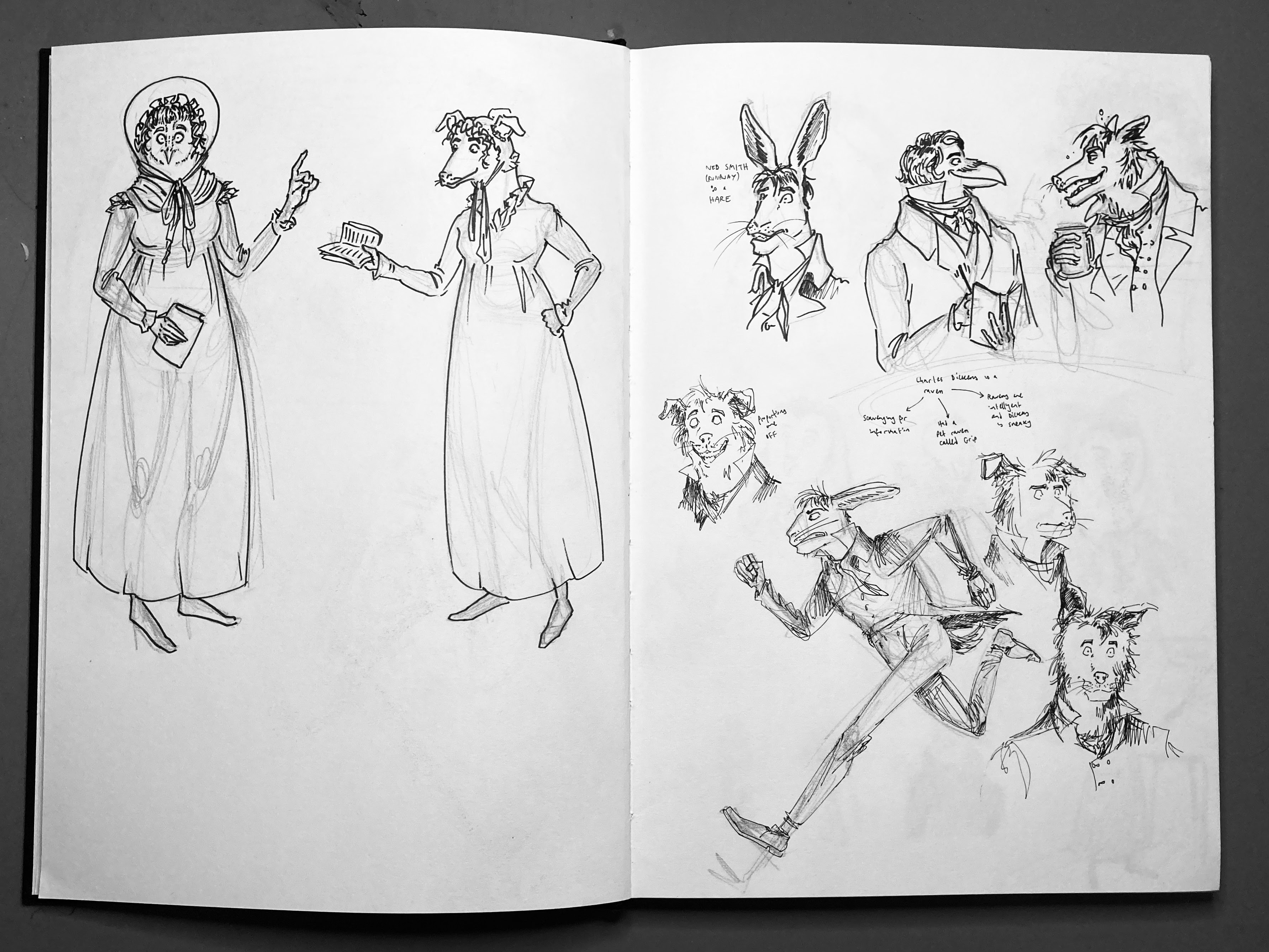
William as a barn owl, and Charley as some kind of dog of mysterious ancestry. Also trying out Bridget in various avian forms.

Bridget as a tawny owl, and Ann as a whippet. Turning these characters into animals raised all kinds of problems - they're married with kids: if I don't want to draw fun hybrids/ abominations then the parents have to be similar species. On the right-hand page, Ned Smith the runaway became a hare, and Charles Dickens became a raven. (Another problem: there's something a bit deterministic if a character is a hare and whoops, he's known for running away but, in this animal-headed universe, he'd have been born as a hare)

The counterfactual bit (ignoring the fact that they're all animals now, but then that communicates that these are not 'true' stories): I wondered what might happen if Bridget and Ann taught girls while their husbands taught boys. I used anthropomorphism to communicate that this isn't backed up by anything obvious in traces of the past. If Bridget had been teaching, William would have probably included something in his adverts about "Mrs Shaw instructs a number of young ladies at the above Academy on very reasonable terms, etc." - but he didn't! I've seen loads of his adverts in The Times (but I know he also advertised in other newspapers that I haven't seen yet), and I haven't seen any other researchers getting excited about anything like this in relation to William and Bridget. 

Then I applied more Blake to William and Charley - William aligned with Reason, and Charley aligned with Imagination. 

Right hand page: briefly swapped them round (William suddenly energetic, Charley suddenly static), and then put them back and used them to respond to Blake.

Started thinking about playing with format, and began working on a writing blank. These things were contemporary with my case study: blank sheets with decorative borders, frequently featuring instructive/ aspirational illustrations, and kids at school would produce a sample of their handwriting in the middle, which was called a schoolpiece. I don't know whether any were used at Bowes Academy. Here's one from 1810 (at the Bodleian) which also has (idealised) scenes of kids at school, even including a very meta one in which a boy shows his schoolpiece to his friends.

Some of the figures around the edges of writing blanks were allegorical, and meant to show virtues (and sometimes vices) that the kids using the sheet should (or should not) emulate. Here's one from 1784 titled 'Emblems for the Improvement of Youth' which depicts things such as Vigilance and Laziness. I used William and Charley's associations with Reason and Imagination to decide what virtues/ traits to depict.

Right hand page shows some definitions from The Improved London Edition of Barclay’s Dictionary, Superbly Embellished, published by J. McGowan, Great Windmill Street, London. c.1812 - definitions such as Reason, Imagination, Empiricism, Tradition, etc. Here's a later edition.

Emblems! Some of the final illustrations for the writing blank. 

Screenshot of the finished writing blank! I need to do a printable version at some point so people can do their own best (or worst!) writing (or drawing!) in the middle and show their friends. (Yes I assembled it in Pages)

Some of the other experiments in this book include...

Trying to communicate emotion without showing characters.

Left hand page: using colour/ media/ mark making to evoke emotions.

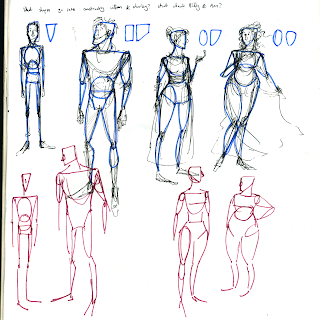
Simplification, I think as a means to boiling down the character designs? I think I was trying to make them look less specific? Not the most fruitful experiment. The most interesting thing on this spread is that part of the left-hand page where I'm analysing the shapes I use to build the characters.

Speeding up drawing to simplify them. 

The final illustrations for my recontextualisation of William Blake's poem The School-Boy are in this one! See SBB for preliminary drawings.


See the pages on my Instagram here: 1 | 2 | 3 | 4 | 5 | 6

See one of Blake's original prints of the poem here.

Then some more ink drawings. These are for exploring the visual contrast between how I designed William and Bridget's body shapes. 


These next ones are for a seminar about historiography and illustration that I did in December 2019. Here's the poster (which has an image I did for an essay for a research module) and here's me waving my arms around (thank you to my splendid friend Colin for the photograph!).

Left hand page: random inky William (nothing to do with the seminar) and a trail of traces of the past. Right hand page: don't trust your sources (what or who influenced the testimonies of people at the ophthalmia trials?) and me messing about with a timeline.

The right-hand page is about interrogating your sources. Questioning stuff and imagining how it might've been used.

More things.
Bridget being ephemeral. We don't know much about her! Preliminary work for one of that set of three panels that very few people have actually seen yet, I really need to show them somewhere - Bridget's panel is here, here is William, and here is Charley

Warm-up work for the ink illustrations for a talk I did in March 2020 for my local history society.

Final illustrations for the windows that I planned in IBF. 

That's it for A4BB. This way for the sketchbook list.

Characterisation of Charley and Ann - or, Beauty and Sublimity

[Looks like I'd started writing this in 2021, and only now I am getting round to posting it. Hang about, we've got the word "su...