Showing posts with label Jonathan Shaw. Show all posts

Saturday, August 5, 2023

PhD sketchbooks: bonus content

There's some stuff in other sketchbooks! And elsewhere!

First, some things for Charley's pages in Disorder. A4 spiral-bound, tan-coloured paper.

Media tests. The one on the left ended up on p.2 in the final comic.


There's two pages in Disorder where Mary Ann and Charley communicate, so I blended their visual languages. More consideration of that in IBJ.

I've also got a big A3 sketchbook which I hardly use because it is enormous

Early visual language test for Charley's pages in Disorder

Ghost Charley

I drew this after a Zoom talk by Beverley Pilcher (who wrote Barnard Castle and the Cholera Outbreak, 1849, privately published in 2004) and this drawing was a response to that. I also put this image on my Instagram.

I tried keeping a book specifically for any information I could find about William's connections (right at the start of doing (U)KA) but I forgot about it after a while, so it didn't go very far. This one's A5.


I had a load of stuff on my wall for (U)KA and most of it ended up glued into this book when I took it down - my splendid supervisor Katie suggested I put up sticky notes with thesis topics on the wall, and I love sticking things on walls

Not a sketchbook, but a prototype publication - the definitions! Based on Frederick Dinsdale's Teesdale Glossary (1849) and Barlcay's Universal English Dictionary (I've got a copy c.1812, this one is 1835). Initial responses to Dinsdale in IBJ, planning for the illustrations in IBL, final illustrations in A4BF.


I know I said that's probably it in the previous post... but I think that these sketchbook posts might be over now. Right. Back to the sketchbook index here.

Tuesday, August 1, 2023

PhD sketchbooks: IBH (28/7/20 - 18/9/20)

Continuing from IBG. This is also a lot of Disorder stuff. (Timelapse video here!)

Still trying to work out some arrangement for the Shaw family on that one page in Mary Ann's visual language (the final version is in A4BC). On the inside of the front cover is a sticky note about drawing as a research tool - partway through Disorder, I realised that, in addition to discovery/ description/ interrogation/ expression/ processing information, drawing can also be used to interpret information. (I added this because history isn't 'discovered' in the archives or wherever else you're looking - you have to interpret things in order to make history.)

Left: working out timing for Mary Ann's panelled pages, wondering what happens if she goes and looks in the back parlour (where some of the infected boys are, and which she does in the final comic), and considering giving William a nightmare. Right: developing Mary Ann's siblings Will and Jonathan, and wondering how to depict their deceased sister Jane. 

Trying out poses/ gestures, and what they might suggest. The writing on the right-hand page is about leaving the exact nature of the family scene to the audience's interpretation - is it Mary Ann's imagination, memory, some sort of alternative present, lost future, idealised situation, or what? (Also Mary Ann demanding I actually get on with painting her pages rather than constantly finding costume reference, trying out compositions, etc.)

First appearance of Jane, alarming William who is kneeling on the floor having a crisis. She died in May 1820, before Disorder is set (late 1820 - early 1821), but she (or her absence) would still have had an influence on her family. In one of his letters to the Brooks family in 1826, telling them that their son had died, he wrote that "... I have no doubt his happy spirit is now with the one I lost some time since, and that both are now better provided for, than being here below ... I sympathise very much with Mrs Brooks and Yourself as your feelings will be indescribable, but the thought of having a little Angel in heaven, how consoling, when calm reason resumes her seat again ..." (quoted in Kirkpatrick, Fact v Fiction, p.124)

Left: analysing visual devices/ recurring imagery that link some of the drawing styles/ visual languages together. Right: analysing a couple of Mary Ann's pages (see the finals in A4BC and A4BD). 


Some writing about doing a paper (which eventually became 'Lines on a Page') and, rather more fun, drawings about feeling like the people in my case study are just out of reach, and how sometimes I see/ encounter/ experience things that remind me of (my interpretations of) them, and also the irretrievability of the past, which ended up with me projecting my thoughts onto William which I sometimes do when I'm having a Not Great Time (like in SBA).

Then more work on Charley's visual language, with some Blake influence. This spread also shows how I sometimes turn my sketchbook sideways and add in not-quite-relevant ideas - in this case, what if William got a book about science and tried making Charley learn it so he could put it in his adverts? Stuff that can't be proven!

Planning for this image of William lying in a graveyard! It's about voicelessness! I printed a copy of an article about the ophthalmia trials from the Hull Packet from 10 November 1823 (article titled 'Cruelty of a Schoolmaster', how embarrassing for him), covered it in household emulsion (making sure that the words were still visible), then drew William over the top of it in graphite.

Right: sometimes I can be planning a project for a long time and then suddenly things just line up stunningly - so here I began to make Disorder (or, as it was then, Despaired Of) make sense. I suddenly had ideas for more of the pages, whereas before I'd just been doing one page at a time, responding to whatever I'd done previously with the next one. (This is probably something to do with how, if you let ideas sit in the back of your head and concentrate on something else, your subconscious gets to work and sometimes turns up the goods. Or mine does, at least. I'm sure there's literature on this but I'm looking for it in the wrong places at present.)


More Disorder planning.

Another version of upside-down William, and a comic that I could have put at the end of Disorder, but for some reason didn't? I think it just turned into a historiographical minefield: lots of spicy business about breaking the fourth wall, the power of the historian in representing people from your case study (do they have a say? they're only your interpretations, oh no here we go again), emphasis on creative/ practical aspect of research, interpretation, imagination, etc. 

There's a lot of writing in this sketchbook. Find a more exciting one on the list. 

Friday, May 14, 2021

Exciting news about Mary Ann Shaw and Emily Shaw

We don’t often hear stories about women involved in the Yorkshire schools, so here’s some things I’ve found relating to two of William and Bridget Shaw’s daughters! Yes, it’s news about them from after the main bit of my case study (my project title specifies 1814 - 1840) but it’s exciting anyway.


News about Mary Ann!


Mary Ann Shaw was William and Bridget’s oldest child, born on 8th September 1811, according to the excellent and useful Laidman one-name study site. She was baptised on 21st September 1811.


I have strong reason to suspect that she had some responsibility in the school and was involved in supervising the boys. There’s a letter from her dad to Mr and Mrs Brooks, the parents of a very ill boy, in which William says “my daughter observed him sitting up in bed” - this is from February 1826, when Mary Ann would have been 14. (What about her sisters? Wouldn’t they have been old enough? No, they wouldn’t - and that’s involved with the next bit of news. You’ll have to wait.) There’s also an account given by Robert Lamb, allegedly the son of a maid at Bowes Academy, and nephew of a local coachman - Lamb says that the pupils at the Academy were “properly looked after by Mrs Shaw or Miss Shaw”. (Get all this information and more in my favourite book, Charles Dickens, Nicholas Nickleby and the Yorkshire Schools: Fact v Fiction by Robert J. Kirkpatrick, published by Mosaic (Teesdale) Ltd., in 2017.)


And here’s the really exciting bit: I’ve found a photograph of Mary Ann Shaw.


Alright, she wasn’t called Mary Ann Shaw at the time the photograph was taken - she was Mary Ann Bousfield by then. She married a local chap, John Bousfield, after William’s death, and they occupied her parents’ house. Apparently they neglected the old schoolroom and allowed it go to ruin.


Anyway, here’s how I found her. The Bowes Museum has a copy of a book called Dickens in Yorkshire by C. Eyre Pascoe, published 1912, so I tracked down a copy for myself. The author goes up to Teesdale and goes to places where Dickens went, interviews local people, and generally sees the sights. He doesn’t explicitly refer to the Shaw family by name, although, after much beating around the bush, he remarks (very hedgingly) that “Local tradition says that Wackford Squeers was one “Dr. Shaw.” It is so recorded in guide-book literature to the present day.”


Pascoe doesn’t seem too fond of William, but he is extremely fond of Mary Ann and Bridget, and Mary Ann's daughter. He refers to Mary Ann herself as “Miss Fanny Squeers”, going by the reckoning that, if Wackford Squeers = William Shaw, then Fanny Squeers = Mary Ann Shaw. Here’s what Pascoe says on pp.28-29:


“If I met one person I met half-a-dozen who assured me, that Miss Fanny Squeers, in propriety persona actually lived at Dotheboys Hall, and married a gentleman of the neighbourhood. I was shown that lady’s portrait - the pleasing portrait of a dignified-looking lady of middle age - and (as it were) asked to accept that as the “counterfeit presentment” of Dickens’s own Fanny Squeers.”


And then turn the page - and there she is!


Delight! Wonder! Marvellous discovery! Here is the face of a woman who had, in her youth, been involved in the running of a Yorkshire boarding school.


(Meanwhile, Pascoe is having delight and wonder of his own, as he declares that if he’d have been born earlier and in the right location, he’d have wanted to marry her. Bit awkward. Gets more awkward when he sees a photograph of her daughter and wants to marry her, too. Oh dear.)


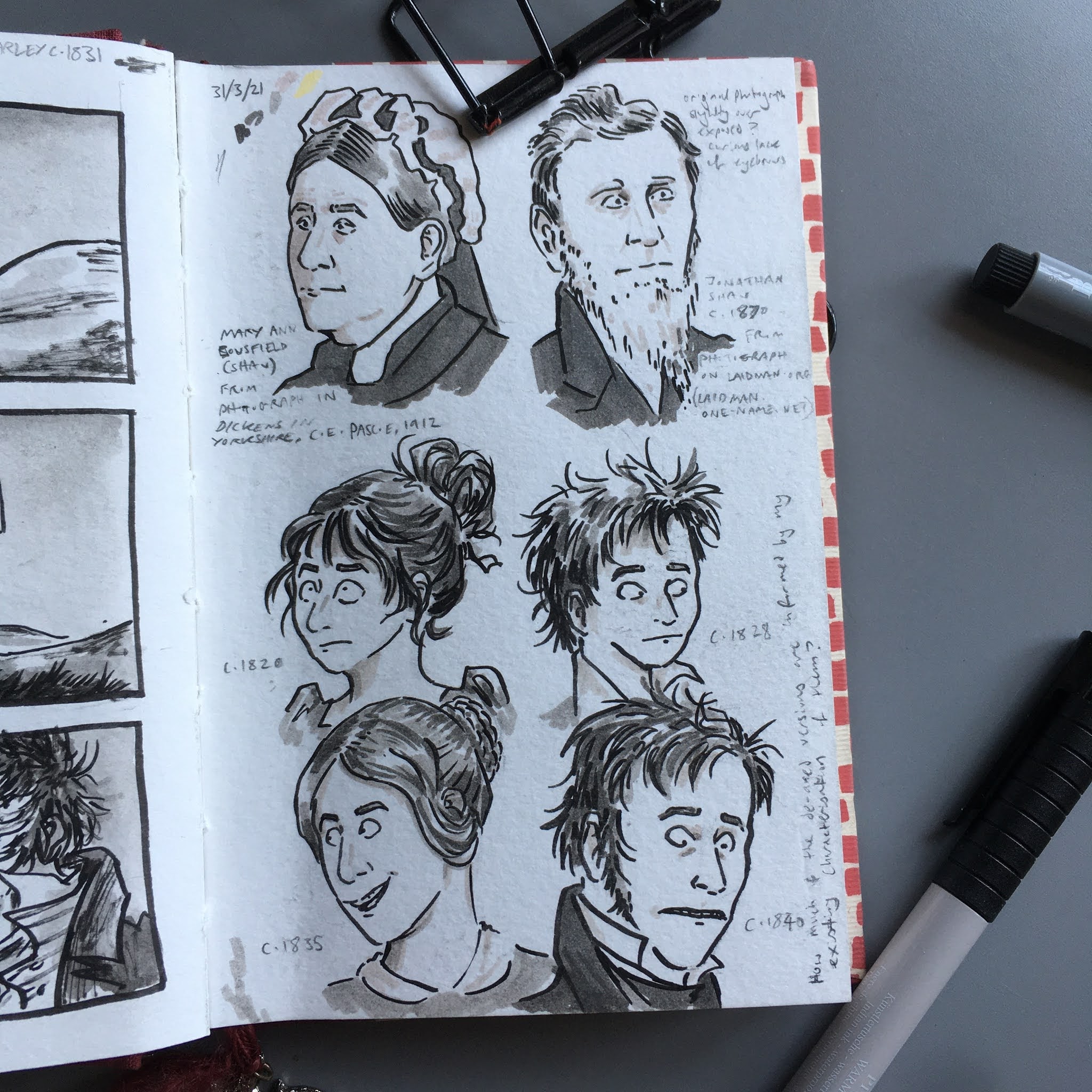
The main implications for my work mean I’ve got to redesign Mary Ann a bit, but that won’t be a problem. 


De-aging Mary Ann - and her brother, Jonathan, whose photographs are on the Laidman site: here he is on his own c. 1870 - and here he is with his family, c. 1874 - and here is another version of the c. 1874 family photo. 


News about Emily!


Alrighty! The Laidman site says that Emily was born on 9th March 1825, and baptised on 19th March 1825. She married a chap called Frederick White, and they had a son, also called Frederick White - and that’s all we have.


Or is it?


I’m currently working on the introduction and conclusion to my weird graphic history-comic-experiment, Disorder. There’s a bit about Mary Ann, and how the unnamed daughter in her dad’s letter to Mr and Mrs Brooks could only have been Mary Ann due to the dates. Her sisters Jane (1822 - 1914) and Emily (1825 - ????) would have been too young to be involved in looking after the boys in 1826. 


That set of question marks in Emily’s dates vexed me. Laidman.org had given me a couple of dates and a couple of names, so I went dashing off to FamilySearch to see if I could dig them up. Lo and behold, I got her marriage record and, also quite exciting, a mention of her and Frederick getting married in the Newcastle Courant, in which she’s described as the “youngest daughter of the late William Shaw, Esq., of Bowes”.


I tracked the couple through the censuses - in 1861, they’re living in Lambeth. Oddly, it looks like they’re going as Mr and Mrs Waite rather than White, but that could be a transcribing error or something. Emily’s husband Frederick is the manager of a bottle warehouse, and they’re living with their kids Emily and Frederick, a servant called Anne Cockling, and an ex-governess called Elizabeth Mary White. The listing on FamilySearch gets a bit weird here because it says that Frederick (aged 39) is the head of the household, but Elizabeth Mary (aged 52) is his daughter. Could be another transcribing error or something. Might be worth looking at the actual census documents to try working out what’s going on here. 


In 1871, they’re at Marylebone (via Camberwell and Brixton, if you look at where their kids were born) with offspring Emily J., Frederick, and George N., and Ann Gulley, a servant. In 1881, they’re living in Battersea, but now the household is just Emily, her husband Frederick (who is now an accountant), and their son George H., who is a bank clerk. 1891 is the last census that they both appear in: still at Battersea, now living with their son Frederick (another bank clerk), and servant Anna Cox. They’re given the surname Waite again. 


Next step: Find A Grave! And find a grave is exactly what I did - I found Emily White, who was born on 9th March 1825 (matches up with Emily Shaw), who was married to Frederick White (another match), and who had a son called Frederick White (another match). Emily died on 19th December 1897 at Clapham, in the London borough of Lambeth, aged 72, and she’s buried at West Norwood, also in Lambeth.


Mary Ann reads to her sister Emily, c. 1830.


So yeah! Here is the news, regarding people who died in the nineteenth century. My favourite type of news. As usual, if you have access to drawing implements and a suitable surface, and you fancy making your own characterisations, I'll encourage you to do it!

Characterisation of Charley and Ann - or, Beauty and Sublimity

[Looks like I'd started writing this in 2021, and only now I am getting round to posting it. Hang about, we've got the word "su...