Showing posts with label history. Show all posts

Tuesday, January 16, 2024

Drawing and deconstructionist history (I did a talk for the UoG Illustration students)

Today I had the honour of giving a talk to the illustration students at the University of Gloucestershire! I did the first in a series of Visiting Artist Talks in the massive lecture hall at Francis Close Hall. Huge thanks to Tom and Kim for inviting me and facilitating the event, and thanks to the illustrators for coming to watch and listen (and especially to those who played bingo and/ or gave me your feedback!)


The itinerary!

I started my BA in Illustration at the University of Gloucestershire in 2012. In my final year, our then head of department KP wondered about setting up the MA, for which I was well game - I wanted to see where I could take my illustration practice next, how I could push it in new directions, how I could use it for research. Then, towards the end of the MA, we started wondering about how the Illustration department could do a PhD - then there was a year of trying to get it off the ground - and then eventually, in the autumn of 2018, I started it!

This is the bit where I ask everyone if they've heard of Charles Dickens. Then I ask if they've heard of/ read/ seen an adaptation of/ etc Nicholas Nickleby. That's most people's gateway into the Yorkshire schools.

Here's where I give a brief overview of the Yorkshire boarding schools - popular from c.1750 to c.1850 - usually aimed their adverts at middle-class parents in cities (often London) - reasonably priced (compared to some schools like Eton and Harrow and that) - also the curriculum is broader (and more useful) than those expensive schools, covering stuff that you'd need if you're going into a mercantile profession or whatever.

(Exactly 203 years ago William was in London, meeting parents and new pupils, haha wow)

Blog post about my case study here

During the last year of my BA (2014-15), for my final major project, I researched, wrote, and drew a nearly-finished graphic novel about the terrible misadventures of a fictional boy at Bowes Academy. I went to archives, did site visits, generally had a great time... Unfortunately I was still heavily influenced by Dickens's Dotheboys Hall, and I had no idea how historians do what we do (I thought it was all about Finding The Facts haha wtf) and the result, Bad Form, contained interpretations that I no longer support. (I'm glad I never finished it and it never saw the light of day.)
 
One of my reasons for doing my PhD about this case study was to see how my interpretations had changed. This slide shows how my depictions of Bridget and William changed (and my drawing style too). At the top of the slide is a panel from Bad Form (2014-15), and then in front we've got Bridget and William from about 2019.

This was great - I asked the illustrators to shout their ideas at me, and fortunately they all said very sensible things about creating interpretations, going on site visits, viewing things in museums, and interviewing people who were involved or whose relatives were involved. I am relieved and delighted to say that nobody came out with any nonsense about 'finding the facts to tell the true story about what really happened in the past'!
We make evidence-based interpretations of traces of the past, using a load of other considerations! Unfortunately not everybody likes to acknowledge these. It's usually your more traditional historians who tend to forget themselves and their subjectivity and creativity and imagination and such in creating their interpretations.

I've got a blog post about Alun Munslow's categorisation of historians here!


The past is gone and we can't get it back (which is not a bad thing when we think about various embarrassing situations). History is what historians make: it's how we communicate our ideas about the past.

Some of the things I used in creating my interpretation of William Shaw (blog post on that here).

When Dickens and Phiz went to Bowes, it's extremely likely that they saw Shaw, and used him as visual inspiration for the villainous Wackford Squeers, who, like William, is another short and peculiar one-eyed schoolmaster who wears a lot of black. Some of Shaw's old pupils recognised him in Phiz's illustrations, and Phiz's son asked him what the original was like, and Phiz said that the illustrations were "not unlike him". So I used Phiz's Squeers, translated him into my drawing style, then de-exaggerated him to get an interpretation of what William's face might've been like.

Horatio Lloyd had gone to Bowes Academy in the early 1820s (evidently around or after the ophthalmia scandal, as he described William as having damage to one eye), and grew up to become a famous actor and wrote an autobiography which came out in instalments in the Glasgow Weekly Herald in 1886 (read it here). He described the schoolmaster, which gave me clues about his physical appearance, including things to search for in museum collections online so I could give him clothes (extant costume and contemporary prints are your friends).

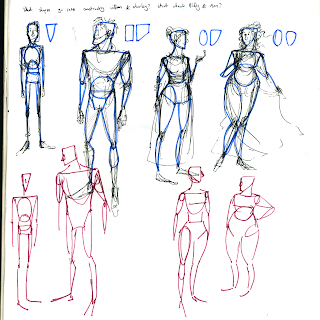
I don't like to build my characters one at a time - if I create a bunch all at the same time, I can bounce ideas around between them and make them contrast against each other more effectively. (And I like to revisit them and change them later! Never leave your characters set in stone - history is a constantly changing discipline, interpretations change all the time.)

When I was building William, one of the others I was building at the same time was his head usher Charles Hopkins Mackay - I created Charley as my representation of my ideas about him. We don't have any evidence about what anybody else in my case study looks like apart from William (and some mid- to late-19th century photographs of Mary Ann and Jonathan, two of his and Bridget's children, and some of his ex-pupils). So nothing about Charley - so that means I have free rein to make him look how I like! (Within reason, I'd need to provide good explanations if I start doing weird things like turning him into a wolf or something hahaha whoops)

I wanted to use contrasting character designs to explore the potential power balance between the two schoolmasters. William is at the top of the hierarchy in Bowes Academy, and is physically small, Charley has less authority - what happens if I make him big and muscular?

I also used their adverts. Earlier we saw one of Shaw's adverts - he seems very professional and to-the-point. Mackay, meanwhile, is very verbose in his adverts, and goes off on tangents, and gives some slightly dubious autobiographies. (Scroll down this pamphlet from 2019 to see a bit more on this.) I used this to give them contrasting behaviours in the schoolroom: William is very reticent, whereas Charley is much more expressive. (Based on my observations of the behaviours of lecturers and my own presenting style!)

I brought in some near-contemporary concepts from William Blake - Reason and Imagination. Reason is all passive, restrained, conventional, orderly, static, and tends to accept stuff. Imagination, on the other hand, is very active, energetic, revolutionary, dynamic, and tends to question and challenge stuff. Using the above business with the adverts, I aligned William with Reason and Charley with Imagination, which gave me another contrast to play with.

Single statements and broader interpretations! A single statement is more usually known as a 'fact'. This is a small thing. A work of history (usually containing a number of these) is a broader interpretation. For instance, this could be when your historian has put a bunch of single statements together and needs to join them up somehow, or when they've decided that this specific statement definitely means this, or when they build a narrative out of things - anything like that.

Here's our example. Charles Mackay was involved in teaching. Ok - we've got his adverts (just seen), and all these bits saying that he was an assistant in a school or he was operating on his own in some educational capacity. But what sort of teacher was he like?

We don't know what kind of teacher Mackay was! That's the broader interpretation. I can suggest different ideas about him using drawing, but these are interpretations, not facts. (I like to interpret him as being very enthusiastic but I genuinely have no idea.)
Traditional historians like to think that they can make things that correspond exactly (or close enough) with what really happened in the past, and for some reason it always looks like a very specific style of academic prose, usually with a linear narrative and some cause-and-effect and the meanings behind things and some sort of analysis and all that sort of business. I had no idea that the past was just words, and that it was so neat and tidy!

Correspondence theory is total wack and the next slide contains a very quick example as to why that is.
Neither of these things are William Shaw. One is a couple of words. The other is a drawing of a character that I created to represent my interpretations of what he might've been like at a certain point in his life. Neither of these are the man himself.

The things that I make do not correspond with what really happened in the past (whatever that might be). I can't show you exactly what this schoolmaster looked like, never mind how he behaved or what he thought, or any of the events he was involved with. 

By doing history using drawing, rather than your traditional written history, I can point out that this is my subjective interpretation. I'm not hiding behind a wall of words. I created this - you can see where I moved the pen across the page. All those marks become traces of my activity, of my hand moving across the paper.


History should not be limited to a specific style of writing as not everybody is comfortable with writing (and it's even worse if you restrict it to only being allowed to do it in certain ways!). So we need experimental history: drawing, performance, re-enactment, film, music, sculpture, all sorts of fun stuff.

Some traditional historians don't like experimental history because they believe that none of these methods are nuanced and subtle, and none of them can have the proper references and all that. But if we don't experiment, then how are we going to be able to find out how to make them nuanced and subtle and referenced?

We're having another crack at correspondence theory. We're using experimental history to explicitly point out that our representations of our ideas about the past are not the past itself - that's what Alun Munslow is talking about when he says experimental history tackles the relationship between "the reality of the past and its correspondence in the text (or in any other mode of expression)". 

Here's a selection of pages from my graphic history/ comic Disorder. (Available as a free PDF via this post.) In Disorder, I explored an incident that I'd only seen mentioned briefly in a couple of trial reports: apparently, when Bowes Academy was afflicted by ophthalmia, William nearly died - his life was despaired of - presumably due to the stress of the situation. I used a few different visual languages (drawing styles) to speculate over what some of the people involved might have thought/ experienced at the time.

Every event will have multiple perspectives: everyone involved (or who witnesses it or hears about it later) will have different experiences and interpretations and such. Then we can have fun with memory, and with how they relate their tale/s to others, how they make sense of it themself, whether they can commit it to the historical record, whether it survives, who has power over which stories are preserved and which stories are told...


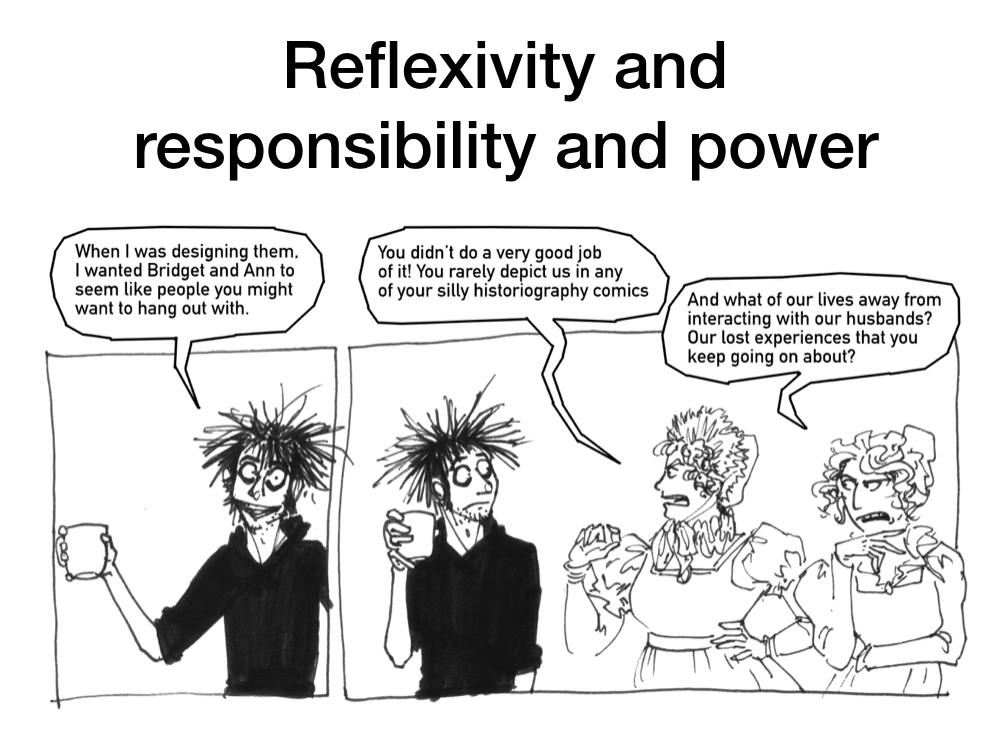
Which leads onto one of the uses of being reflexive about your practice, and thinking about what you do and how you do it: you become aware of your own responsibility and power in how you depict (your interpretations of) the people and events in your case study!

So in this comic (which is from my thesis), Bridget and Ann point out where I haven't done things that I should've done. I use these characters to provide alternative commentary on the stuff I discuss in my thesis, evaluating my work and wondering what might their originals have thought of the way I depict them?

Making your characters self-aware (aware that they are invented characters) is a useful strategy - it points out that, unlike what some more traditional (and anti-theory) historians might say, the history is not speaking for itself. These people are characters who I've made, and they know it. (Well, they themselves don't really, because they're made of ink, but anyway.)

In this slide, Mary Ann gets impatient with me (right-hand side) because I was meant to be painting her pages in Disorder but I'd got distracted on costume reference and such. In the comic on the left-hand side, she's got access to my silly reference photos that I take - she exists in my imagination, so she's got access to all my stuff, including laptop passwords and knowledge of how to open the Photo Booth app. 
Here's a thing that more conventional historians might find a bit trickier if they prefer to do things in writing - using yourself as drawing reference! I have limbs, I have a camera, I make my own pose reference.

Another fun thing you can use in building your interpretations: your own experiences. In November 2020, when I was working on the preliminary sketches for William's pages in Disorder (y'know, in which he nearly dies), my appendix ruptured, which was very inconvenient and somewhat exciting, and I had to have an emergency operation (massive thanks to the NHS for sorting that one out). During my stay in hospital, I barely managed one A5 side of drawing, but some of the imagery from that ended up in Disorder. I still think it's one of the funniest things that's ever happened to me.

By this point, I've been working with some of these characters for so long and at such intensity that it feels like they're just out of reach - they're part of my imagination, they contain parts of me, some of them are now part of me - but their originals are in the past and I can't access them because they're dead. 
Blog post about the historical sublime here!
An example from my work - in the early 1830s, Charles Mackay stopped working for William Shaw. I have no idea what happened. This is another gap for imaginative exploration. (I don't know whether they had a row or what, I just like drawing angry people and teeth)


And with that, we moved onto my recommendations for anyone wanting to take a closer look at deconstructionist history:
  • Rethinking History journal - available via the university's library page, or via Taylor & Francis (login via institution, search for Rethinking History, job's a good'un) - this was set up by Alun Munslow and friends, and has loads of really good articles about historical theory and loads of fantastic experimental history too - for instance, this issue is about graphic novels as history (and was edited by one of my examiners!), and this experimental article is a comic exploring exciting things including metaphor, multiplicity, self-awareness, and the fun you can have with images (and was illustrated by my other examiner!)
  • Library shelfmarks 901 (philosophy and theory of history) and 907 (historical research) - more fun things about how historians do what we do.
  • Work by people such as Alun Munslow (Deconstructing History and Narrative and History are good places to start), Keith Jenkins (Re-thinking History is an excellent primer), Robert A. Rosenstone (does a lot of stuff about film and history, might be useful for different approaches to visual storytelling), and Ludmilla Jordanova (does a lot of very splendid work on using visual and material culture in creating historical interpretations).

And, as usual, if anyone wants any more information or a chat about making interpretations of the past or whatever, DM me at @Ed.smike on Instagram.

Monday, January 1, 2024

Reconstructionism, constructionism, and deconstructionism: fun with Munslow's genres of historians

My favourite theorist Alun Munslow (occasionally collaborating with his excellent mate Keith Jenkins) created a way of categorising historians and their work into three genres: reconstructionism, constructionism, and deconstructionism. I found these categories vastly useful in building my work, and in helping me to identify my standpoint as a historian.

My History supervisor Prof. M. got very excited about this board from my exhibition

Reconstructionists and constructionists are the more respectable, conventional kinds of historians, who Munslow sometimes called "historians of a particular kind"... and they sometimes regard us deconstructionists with suspicion.

Don’t worry about trying to remember who’s who - here’s a handy guide to the three categories I modified from a tasty section of my thesis.


Reconstructionist historians:
  • Believe in the correspondence theory of representation - they believe that what they create (usually written history) corresponds exactly (or close enough) with the actuality of the past. Imagine that! I whack some ink on a bit of paper and - is it possible for it to accurately and adequately represent some historical character or past event? What if I write the name of my protagonist, William Shaw - are those two words an adequate representation of a whole entire person?
  • Believe that, by careful and detached empirical analysis of their sources, they can discover ‘the true story of what really happened back there in the past’. Most of them nowadays are more cautious about this, and say things like 'the most likely story', but it's still there.
  • Believe that they can use writing (usually of a specific pseudo-detached academic type) to accurately and adequately communicate the story of the past. They also believe that narrative is just a vehicle, and not something that you can manipulate to tell different stories, or that can influence how you tell stories - to them, it’s simply the only appropriate way to tell the story of the past. (And it's usually just the story, rarely a multiplicity of stories.)
  • Aim to remain objective and dispassionate (despite the fact that most of them know that total objectivity is an unattainable ideal). They don’t want the history they write to be influenced by their own personalities, contexts, experiences, etc. They seem to think they can somehow rise above their own circumstances to cast an unbiased eye over the past, in order to get at it 'as it really was'.
  • Some of them acknowledge that you can’t really get at ‘the truth’ but they tend to blame their sources, rather than looking at themselves and how they understand things and how they build interpretations.
  • Won’t engage with how narratives work, never mind experimentation with narrative forms and methods of communicating those narratives. They also won’t engage with the distinction between a single statement and a broader interpretation, never mind how these compare against what they believe to be reality.
  • Strongly dislike theory (whether from history or any other discipline) as they believe it’s an imposition onto the past and won’t get you accurate results.


Constructionist historians:
  • Also believe in the correspondence theory of representation and accept that yes, it’s imperfect, but they still believe that they can accurately convey the results of their empirical study of traces of the past in a standard historical narrative.
  • Use narrative as an analytical mechanism, but they still think that they can find the story in the past. (Why is it always the? Not a possible story or a bunch of possible stories? Or even this is openly fictive but let's imagine this for a minute, eh why not)
  • Sometimes like to borrow theory from elsewhere, such as sociology or psychology or economics or something, but they like to make sure it’s appropriate to whatever they’re researching. (How they decide something is appropriate, I do not know. Also, notice how orthodox these other disciplines are - I've yet to hear of any constructionists borrowing something from a more obviously creative discipline, but if you know otherwise, hit me up)
  • Usually aim to be objective, and also acknowledge that that’s very idealised and that it’s impossible to remain impartial.
  • Acknowledge that they’re actively seeking meaning in the past, sometimes by intervening with concepts and theories, but they claim that these are meant to serve the evidence rather than interfere with it.


Both reconstructionists and constructionists:
  • Believe in practical realism: here, this means that stuff that we can’t see right now (such as past events) exists in the absence of anyone perceiving it, and that its existence has nothing to do with its being perceived. This is linked to the correspondence theory we met earlier in this post - where people believe that the representations they make correspond truthfully to reality. (However, the existence of stuff we can’t perceive right now - such as past events - doesn’t necessarily mean that we can represent those things accurately here in the present. And there's loads of lost stuff, too!)
  • Believe in empiricism: they think true knowledge is grounded in what they can experience with their senses. (What the hell is 'true knowledge' and who gets to decide that? Ok let's not start on that one) They want solid evidence rather than stuff that’s a bit wobbly round the edges. They prefer explicit knowledge to tacit knowledge. They’re definitely not going to approve of vibes.
  • Believe that they can represent the past accurately as written history, and that what they write is a very special form of literature that isn’t really literature because it’s actually real. If you call their work ‘literature’, they’ll get a bit twitchy and tell you that their work is based on The Evidence and that ‘literature’ is uncomfortably close to silly things like fiction. Oh, the horror!
  • Believe that their work must be done in writing as they think other forms of investigation and communication - things like drawings, re-enactment, performance, film, sculpture, dance, and all sorts of other exciting things - can’t do the required citations and footnotes and all that, and definitely can’t be as nuanced as words on a page.


Deconstructionist historians (like me):
  • Understand the distinction between ‘history’ (what historians make and do to say things about the past) and ‘the past’ (which is gone and we can’t access it; we can access traces of it, but not the past itself).
  • Understand that traces of the past exist, but our work will never correspond to the past itself. I can draw a few lines, and it’s only a representation of my interpretation of whichever historical character I say it is - it’s not the person themself. Traces of that person’s activities might still exist, such as if they made something, but their act of making it is over. Look at that pencil. The tip is worn where you drew or wrote with it, which is evidence for you having done some action with it (in addition to whatever you drew or wrote). However, you might’ve put it down two seconds ago or used it last week - the actual event of your using it is over and gone. You might pick it up again, but that'd be a different event. The traces of your past activity with the pencil are here, but that activity itself is in the past.
  • Challenge the assumption that language is adequate for representing reality - language is part of reality. It’s not separate. Like how us historians are part of reality, we can’t detach ourselves from it and float mysteriously above it all in order to say things about the past. (I'd include non-written language here, too - using the word 'language' to describe however you want to explore and share your ideas about the past, such as drawing or acting or making puppets or anything else fun. These things are all part of reality, as are the events and people in the past.) 
  • The most likely group to venture into experimental history. We’re more likely to engage with multiple narratives and voices (which the other two groups sometimes like to do) but we also use different methods of exploration and communication.
  • Recognise the presence of the researcher. The history we create is what we make based on our own subjective interpretations of traces of the past (also known as sources or evidence). Our interpretations are not inherent in those traces. Our interpretations are influenced by our personal circumstances, contexts, biases, unconscious stuff, and plenty of other things. It's important to acknowledge this as it influences what we choose to research and how we do that.
  • Recognise the role of the historian as a creator. We don’t ‘discover what happened’ - we encounter traces of the past, then we make interpretations of what we think might’ve (or might not have) happened. We like to be reflexive and self-aware. We understand that the researcher/ creator decides the form(s) that our histories take; the content doesn’t tell us what to do.
  • Believe that the truth is not back there, waiting to be discovered. There are multiple truths, and we can never know or access everything, and this is a good thing.
  • Understand that history is a creative act. History and literature (and illustration!) aren't that different. We're all storytellers. We (usually) use evidence of some kind to make and tell our stories: historians use traces of the past, some fiction writers might use something they overheard, some illustrators might use pose reference or whatever, any of us can find inspiration in our own experiences. We're (usually) invested in our stories in some way, and we want our audience to be invested in them, too. We need to use our imaginations to create and share our stories, and we need to use our creative skills to make our stories memorable and effective. (I've got another spicy bit in my thesis about this sort of thing but I won't post that here today.)

I'm an illustrator (surprise!) and I feel like deconstructionism fits well with my existing illustration practice. I'm very present in my work, I won't pretend to be some detached objective observer - the marks I make as I draw are evidence for my presence. I also use my own experiences as material. As a historian, my stuff is experimental (the majority of historians prefer to write, and would find drawing a bit weird) and then I take it further by encouraging audience participation (you interpret my stuff!). 

I won't pretend that my stuff is accurate, or that it adequately reflects past realities - yeah, accuracy is useful, but I'm not getting bogged down in ok how many buttons on that coat, can I get the exact colour that they'd have painted the wall - my work is more about evoking a multiplicity of possible experiences than accurately describing anything pretending to be reality. 

A deconstructionist approach can be empowering. It encourages a broader range of explorations of (sometimes lost) past experiences, and also encourages more varied ways of interrogating and sharing ideas about the past - not everyone is comfortable with writing, so other methods are needed so everyone can create their histories that help them to build their own identities or commemorate events as a group or whatever other useful things you'd like to do with your histories. We're not stuck with traditional/ established research and communication methods, so we can involve more people with different skills, and generate more insights and ideas.

I have got more on this, so if you want to chat, send me a message (best way is IG: @Ed.smike) - alternatively, fly over to BookFinder and see if you can get your hands on something reasonably priced from the selection below. Have fun!


Further information:
The Nature of History Reader edited by Keith Jenkins and Alun Munslow, 2004
The Routledge Companion to Historical Studies by Alun Munslow, 2000
Deconstructing History by Alun Munslow, 1997
‘Genre and history/ historying’ by Alun Munslow in Rethinking History journal, vol.19 no.2, 2015
‘Modifying Alun Munslow’s classification of approaches to history’ by Eugen Zeleňák in Rethinking History journal, vol.15 no.4, 2011

Saturday, February 25, 2023

The historical sublime is very good fun

Today I want to talk about the historical sublime - one of my absolute favourite concepts! I don’t think it’s as widely discussed as it should be. 

This post is compiled from my notes on the historical sublime, from digging around in some of my favourite theoretical books and relevant articles, and from messages I sent in discussions of the historical sublime when a couple of my friends asked me about it. 


Basically, the historical sublime is the element of chaos and uncertainty in history. 


It’s all fun stuff like incongruities and ambiguities, incomplete bits, disruptions, stuff that just doesn’t make sense, things that put the frighteners up most historians - “the idea that the past has neither rhyme nor reason to it; that it is grotesque, or absurd, or sublime” (p.137 of On “What is History?” by Keith Jenkins) and “… the anarchic, unfixed and unfixable nature of reality - the sublime …” (p.218 of The Routledge Companion to Historical Studies by Alun Munslow).


When you encounter something that you can’t get at - when a person of interest vanishes from the historical record, or things can’t be explained, or something seems uncertain, or if you can’t quite make out what that image is or what that word says, or you’ve got something you can’t communicate in words and it’s more of a vibe, or stuff just gets weird, or anything similar - that’s the historical sublime. It gives us an opening for more imaginative engagement with our case studies, our favourite historical people, our chosen events and situations. In my opinion, more imagination leads to more fun!


It’s hard to pin down exactly what the historical sublime is (which fits with the sublime nature of it) and it’s a big thing in my PhD, so I went through a few books where the authors discuss it and I borrowed some of their words. (If you ask, I can get you the citations for all of them, if you want!)


From what I’ve seen, some historians like to believe that they can find The (Most Likely) Story of What Really Happened - which isn’t necessarily the case! 

The historical sublime forces us to confront the fact that we can’t find that - there’s always going to be bits we’ll never know, and a lot of what we think we’ve ‘found’ can be reinterpreted - so, unfortunately, most traditional historians usually just ignore the sublime. (On a related note, a lot of traditional historians don’t like it when they have to acknowledge that they don’t find stories but create them, based on their interpretations of evidence - but I won’t get tangled up in that right now.)


The historical sublime can also be used by historians (and people from other disciplines who like to explore and experiment with history) in communicating their work.

From what I’ve seen, the discipline of history is set up to favour histories that are neat and tidy, have discernible narratives, and appear to show meaningful connections between things in the past. When the historical sublime pops up - if historians start doing narratives without any particular structure, or random bits of something else thrown in, or other postmodern fun - the disciplinary mainstream can start to get a bit upset.


Here’s Hayden White: “We require a history that will educate us to discontinuity more than ever before; for discontinuity, disruption and chaos are our lot.” (p.50 of Tropics of Discourse by Hayden White) 

        I love the idea of the historical sublime as a method of empowerment! And, of course, anything that historians use can be taken into any other discipline or genre or way of working or anything else that you like! Interdisciplinarity is the future!


According to Alun Munslow, Hayden White uses the term “historical sublime” to mean 

“the celebration of the undiscoverable, possibly meaningless, and open-ended nature of the past. Such a meaninglessness is the only invitation that potentially oppositional and dissenting groups of historians may get to challenge certaintist (e.g. fascist) history. They, and we, empower ourselves when we can find no objective certainty in the past - in the sense of a factual correspondence of evidence with Truth - that can be used to validate the authority of those in power over us.”  
(p.12 of Deconstructing History by Alun Munslow)

        So what we’ve got here is a concept that can be used by less privileged people to challenge dominant historical narratives. It also encourages our attempts to reach/ imagine lost voices of the past - the people whose stories never survived. They’ve gone into the historical sublime. Dominant ideologies might want us to just forget about them.


Let’s have a brief poke at earlier ideas about the word “sublime”, before it started hanging out with the word “historical”. 

In the eighteenth and nineteenth centuries, the sublime was contrasted against concepts such as the picturesque and the beautiful. Those two are like when you encounter something that makes you go “That’s fantastic, I might have to paint that” whereas the sublime renders you awestruck and possibly a bit afraid but, like, in a good way. 

Thinking about the time when these concepts were really hot, “[Hayden] White argues that … [when history was developing as a discipline in the 19th century] narrative history took on the form of the ordered, the measured and the beautiful, as opposed to a view of a past that lacked these aesthetic proportions, so that the aesthetic tamed the irregularities and grotesqueness of the sublime.” (p.141 of Jenkins, On “What is History?”


As far as I’m concerned, the past (and representations that we make about it) should be allowed to be wild and prolific in its sublimity, exuberant in its mysteries, while efforts to control it (such as attempting to insist on One True Story at the expense of others) should be scuppered. By not imposing a single narrative on the past, more people can be empowered to build their own past-based narratives! 


So there’s a kind of optimistic overview of the historical sublime. I need to do more research into it (I want to do a postdoctoral thing on it) but yeah! Enjoy!

Friday, May 21, 2021

Some stuff about William Shaw's Bowes Academy, 1814-1840 (from a talk I gave in March 2020)

I just realised I haven’t got a blog post about the case study itself! That being the historical thing I’m investigating, and making my drawn experiments around - it’s William Shaw’s Bowes Academy, which he ran from 1814 to 1840. 

This is a lightly trimmed and mildly edited version of the talk I gave to CDHAS in March 2020, with most of the illustrations, and with extra images! 


Test drawings of Dickens, based on a few extant portraits. 


You’re heard of Charles Dickens, right? Have you read/ watched an adaptation of Nicholas Nickleby? Remember Dotheboys Hall, the dodgy boarding school run by villainous schoolmaster Wackford Squeers?


That fictional school was based on some actual schools. These ran from c. 1750 to c. 1850, with a few stragglers either end, mainly in Teesdale on the North Yorkshire/ County Durham border. 


They advertised at middle-class parents, typically in London. The parents often had certain aspirations for their offspring, which are reflected in the classical and commercial curriculum offered by these schools. Classical subjects were what the upper classes taught their kids (stuff like Latin and Greek) while commercial ones would be all the things you'd need if you were going to go into a profession or become a merchant or something. This was usually stuff like book-keeping, maths, geography, sometimes French, that sort of thing. The youngest boys at these places were usually about six, but the top of the age range was 21 - once you’re 21, you’re legally an adult, and you’re responsible for yourself, and you can’t be kept anywhere.


(There were some schools for girls, but not many, and their subjects usually focussed on things that helped them run a household, were useful when entertaining, or looked cool at parties. A bit of reading, dancing, sewing, and so on - and sometimes drawing!)


Let’s imagine it’s the early nineteenth century, you’re a middle-class parent, you’ve got a son who needs an education, and you’re reading the Times. You spot this advert.


That screenshot is a bit hard to read, so here's the transcript:

EDUCATION, by Mr. SHAW, and able ASSISTANTS, at BOWES ACADEMY, near Greta-bridge, Yorkshire. Youth are carefully instructed in the English, Latin, and Greek languages, writing, common and decimal arithmetic, bookkeeping, mensuration [measuring], &c., and are provided with board, clothes, and every necessary, at 20 guineas per annum each. No extra charges whatever. No vacations. N. B. The French language 2 guineas per annum extra. Further particulars may be known on application to Mr. Timberlake, 25, Great Marylebone-street; Mr. Annison, 10, Bedford-court, Covent-garden; and Mrs. Young, Plough-yard, Crown-street, Soho. Mr. Seaton, agent, 91, Whitecross-street, St. Luke’s, will give the most respectable reference to parents who have been at the above seminary since last July, seeing their sons. Mr. Shaw attends at the George and Blue Boar, High Holborn, from 12 to 2 o’clock daily, where cards of particulars may be had.


Fantastic! This is exactly the sort of thing you'd have been looking for. He seems sharp, professional, and to-the-point. This particular advert dates from January 1823, but it’s typical of Shaw’s adverts.


(In today’s money, 20 guineas is about £1200. As a nineteenth century person, you’d have heard of Greta Bridge because it’s on the Great North Road, one of the main coaching routes, and your letters would have gone through there if they were off to Scotland. “No vacations” isn’t as alarming as it sounds to us in the twenty-first century - people believed that holidays interrupted kids’ learning, as well as being a bit impractical with all the logistics of bringing them home from school and sending them back again in a few weeks.)


This is Bowes Academy, run by William Shaw from 1814 to 1840 - my case study. This is peak Yorkshire school: Shaw was active when the schools were at the height of their popularity, and his establishment was in the epicentre of the geographical area. His school is also one of the better documented establishments, and, at the height of his influence, had between 260 to 300 boys.


Shaw was born in 1782, allegedly in London, and his family may have originally been from Teesdale, but I haven’t been able to track them down yet - there’s quite a few William Shaws in the records. We don’t know anything about his early life.


Horatio Lloyd, one of Shaw’s old boys who attended in the early 1820s and grew up to become an actor, described the schoolmaster in his memoirs, published in the 1880s.


“A sharp, thin, upright little man, with a slight scale covering the pupil of one of the eyes. Yes. There he stands with his Wellington boots and short black trousers, not originally cut too short, but from a habit he had of sitting with one knee over the other, and the trousers being tight, they would get "ruck'd" half way up the boots. Then the clean white vest, swallow tailed black coat, white neck tie, silver-mounted spectacles, close cut iron-grey hair, high crowned hat worn slightly at the back of his head - and there you have the man.”


So here he is, in the inn, and it looks like some other parents and guardians have already left their kids with him. Let’s follow the schoolmaster, about 250 miles or so up the Great North Road to his establishment, and we’ll see what daily life might be like for them.


Comparison between an image of Bowes Academy from c. 1840, and one of my photographs of the place from 2015 (since lost due to iCloud deciding that it does what it wants).


The boys got up in the morning, rolled out of bed, and were given an old quill pen - which they used for catching fleas. All you do is put the open end of the quill over a flea, which jumps up and gets trapped, and then all the quills are gathered up and burnt. The accommodation is a bit basic, but the establishment is very reasonably priced. 


Next they went downstairs into the yard to wash at the pump. It was probably a bit of a scrum - there’s around 280 other lads wanting to wash, too. Then they would have dried themselves at one of two towels on rollers, but the bigger boys weren't very good at sharing, and snatched the dry part of the towel away from the younger ones.


The pump from imagined viewpoints, July 2018.


Time for breakfast! It’s hasty pudding - the recipes I’ve found suggest that it was usually just flour and water, sometimes with a bit of salt or butter. Apparently a lot of oats were used at Shaw’s place, so I imagine some of those would have ended up in the mixture. I’ve tried the ultra-cheap flour-and-water version of it, and it’s not that bad. 


Having looked at some contemporary teaching books, school would probably have begun with a collective prayer, and then the first lessons of the day. This may have been reading, probably followed by writing in copybooks.


Here’s what part of the schoolroom might have looked like. Shaw would have got the best desk - some of the contemporary teaching books recommend that the master’s desk goes on a podium. Here’s Charles Mackay, Shaw’s head usher - in today’s school, Shaw would be the headteacher, and the ushers would be equivalent to the ordinary teachers, so Mackay could have held a position similar to assistant head. He’s also teaching. Some of the other ushers were older boys, who will go into the profession and become schoolmasters themselves. 


At dinner, the boys would usually have had meat and potatoes, but there was bread and milk on Thursdays, some sort of flour and water dumplings on Fridays, and something described by William Jones (remember that name) as “black potatoes with a bit of butter” on Saturdays. Once dinner was over, they probably back to lessons until teatime. The boys most often have brown bread, with watered-down milk. On Sunday, they had something called broth, but which the boys knew as pot-skimmings, and sometimes there were maggots in it. I told you it was cheap! 


I’m not exactly sure what they’d have done in the evenings, but I’d imagine they would be encouraged towards more scholarly pursuits - contemporary authors of educational books seemed most impressed when kids spent their free time in reading or doing something else improving. 


Then they were off to bed. Four or five of them slept in a bed - although Mackay swore there were never more than three in a bed, and, if he knew that there was, he’d have had them moved - and, in the middle of the dormitory, there was a big tub, which today would be referred to as a public convenience. William Jones said it was flowing all over the room.


Drawings from photographs I took on a trip to Barnard Castle, September 2019. 


Sometimes the boys would have enjoyed days off, and they’d have wandered across the moors, and Mr. Shaw would instruct them not to come back until sunset. Sometimes they smuggled food away from their meals, and saved it for a picnic later. When they wanted money, the boys would look for things to sell; sometimes they caught young jackdaws, trained them to speak, and then took them to Barnard Castle (the market town four miles up the road) to sell as pets. 


Hold on a minute - how do we know so much about life at Shaw’s place? We’ve got a few sources, including quite a lot that show the establishment in a positive light, but one of the most valuable was the evidence given in a couple of trials involving William Shaw in 1823. 


The first trial was brought against Shaw by the parents of William and Richard Jones. Young William had been seven when he and his then ten-year-old brother Richard first went to the Academy in 1819 - now it’s 1823, William is completely blind, and Richard can only see in strong light.


So what happened to them? The conditions at the Academy were basic, sanitation was unsanitary, food wasn’t quite up to scratch, and there was a fair bit of overcrowding. The place was an ideal breeding ground for ophthalmia.


Its full name back then was Egyptian ophthalmia, since it was allegedly brought back by soldiers returning from the Battle of the Nile in 1798, but it’s now known as trachoma. (That link is to the World Health Organisation; at the time of writing, it doesn't contain any graphic images.) Trachoma is highly contagious, particularly in crowded circumstances, such as in a school where everybody’s sharing beds and towels, and washing in standing water, and not receiving the best nutrition. The more you get infected, the higher your likelihood of losing your sight - which is exactly what happened to a few people at the Academy, including William Shaw himself. If we remember what Horatio Lloyd said earlier, Shaw had a slight scale over the pupil of one of his eyes - this is a result of the ophthalmia.


Interestingly, according to a medical journal of the time, commenting on the trials, there was an ophthalmia epidemic in the village of Bowes itself, but I’ve yet to track down more on that.


A couple of panels from the first page of Disorder


Head usher Charles Mackay gave evidence on Shaw’s behalf, and said he became aware that some of the boys had something wrong with their eyes in August 1820. In November, Henry Benning, the local apothecary and surgeon, was called in to look at the boys’ eyes, and was consulting until at least a year later.


Working out Sir William Adams' face (later known as Sir William Rawson) based on his portrait. 


In December 1820, William Jones had written home mentioning his eye trouble. Turns out that he was only one of several infected boys - in one of the rooms that another lad, James Saunders, was quarantined in, there were about fourteen or fifteen of them. This was 14 or 15 particularly bad cases out of approximately 280 - there will be other cases within the rest of the school population, but this is just over 5%.


In March 1821, the Jones brothers went home. Shortly after this, Sir William Adams - the most renowned eye doctor in the land, and the Surgeon and Oculist Extraordinary to none other than King George IV when he was Prince Regent - was called in. Shaw seemed willing to part with any amount of money in an attempt to sort out the problem. He could afford it - even if about 80% of the boys’ parents could afford to pay the 20 guineas fees, that’s over £4700; he also had properties throughout the village, and he was getting rent from these, and he also ran a farm.


At some point, according to Benning, Shaw’s life was despaired of - the stress of the situation had an impact on his health. (This is the incident that I explore in Disorder! Still trying to get the conclusion finished.)


In his defence, there is evidence that suggests Shaw personally tried to help the boys, or at least to cheer them up - not least because he lost an eye himself to the disease, which he could only have done if he’d have been infected multiple times, likely from contact with other victims. According to Lloyd, Shaw would sometimes play the flute for the entertainment of boys who were unwell. (I don’t know if Lloyd was there at the time of the epidemic because he’s very imprecise with his dating, but he did mention Shaw’s damaged eye.)


Screenshot featuring Benning, from the current draft of the introduction to Disorder

According to a couple of witnesses, the care shown by William and Bridget Shaw was practically parental. They tried to help, and they got one of the servants to constantly attend to the ill boys. Some years after the trial, Shaw actively invited parents to visit the school, showing that they had nothing to hide.


Even during the Jones brothers’ stay, the school was accepting visitors - admittedly, Shaw would come into the schoolroom and ask the boys who didn't have jackets or trousers (because they were being mended) to hide under the tables - but the conditions were not that exceptional for an early nineteenth century boarding school. 


Back to the trial. The jury retired for half-an-hour, came back again, and declared that they’ve found Shaw guilty. The judge summed up, and the verdict was that Shaw had to pay £300 damages to the Joneses. (In today’s money, this is over £17000.)


The day after the Jones vs. Shaw trial, the schoolmaster was back in court - another family, the Ockerbys, brought an action against him for neglect, as three of their sons lost their sight under Shaw’s care. During the trial, Shaw had a brief word with his defence team, and pleaded guilty. The trial was over quite quickly, and the Ockerbys received £300.


Preliminary designs for Mrs. Ockerby and one of her offspring. 


All went quiet for a few years. I’m not sure to what extent the ophthalmia trials affected Shaw’s business, but he did not shut down - it’d take something much bigger than a trial reported in the newspapers to deter people from sending their kids to him. Some people were quite sympathetic towards him - the court, including the judge, all agreed that they’d learnt that he’d done his best with regards to the boys’ education, morals, clothes, and food - it’s just the healthcare that was slightly lacking.


However, at some point around 1830, relations between William Shaw and Charles Mackay broke down. Some sources suggest that Mackay chose to leave, while others say that Shaw fired him. We don’t really know exactly what happened.


Either way, he was out. Since he had the relevant teaching experience, he took off to Barnard Castle and set up a day-school for local kids. Some of them could even have been the offspring of boys he taught in the earlier days of his career! He taught here around 1838, when a Mr. Browne and his friend visited the area.


Mr. Browne was looking for details about local schools - he claimed to know a widow in London whose son required a reasonably priced education. Mr. Browne and his friend may have been particularly interested, for some reason, in more scandalous stories of horrors and such. Mr. Browne was not who he said he was.


Mr. Browne was, in fact, Charles Dickens. His friend was the real Mr. Browne - Hablot Knight Browne, the illustrator, better known as Phiz - and they were doing an undercover investigation. There was no widow, and no small boy - but there was an idea that Dickens had about exposing the purported horrors of the Yorkshire schools. 


He’d heard all sorts of nasty things - there’s some tale about a child with an abscess that his schoolmaster tore open with an inky penknife, and the wound got infected and the boy died - now, that’s not true, and the boy in question actually operated on himself with the knife and the ink, and was called John Crosse Brooks and grew up to become the Vice President of the Society of Antiquaries, and died in 1897 - but Dickens had this idea that the Yorkshire schools are all pits of despair and he wanted to sort them out.


Working out Phiz's face based on extant images of him. 


He spoke to a few locals, including a solicitor who tried to change the subject every time the schools were mentioned, but then advised against sending any child to any schoolmaster - at least, that’s what Dickens said - to be honest, I’m not pleased about his research methods. All this undercover business would never get past the research ethics committee at my university. 


At some point, Dickens and Phiz got to hear about William Shaw, and decided to pay him a visit, hoping to look round his school and get some ideas for this story that Dickens was cooking up. Shaw, however, had heard a rumour that there was an undercover journalist from London sniffing round. He didn't want to be dragged through the press like he was in 1823, and politely refused to allow them to see his school.


But Dickens and Phiz had seen enough. In March 1838, the first instalment of Nicholas Nickleby appeared, and the reading public was introduced to Wackford Squeers, villainous schoolmaster and proprietor of Dotheboys Hall. Here’s Wackford’s advert from Chapter 3:


"Education. — At Mr. Wackford Squeers's Academy, Dotheboys Hall, at the delightful village of Dotheboys, near Greta Bridge in Yorkshire. Youth are boarded, clothed, booked, furnished with pocket-money, provided with all necessaries, instructed in all languages, living and dead, mathematics, orthography, geometry, astronomy, trigonometry, the use of the globes, algebra, single stick (if required), writing, arithmetic, fortification, and every other branch of classical literature. Terms, twenty guineas per annum. No extras, no vacations, and diet unparalleled. Mr. Squeers is in town, and attends daily, from one till four, at the Saracen's Head, Snow Hill. N.B. An able assistant wanted. Annual salary £5. A Master of Arts would be preferred."


Here’s the first illustration featuring Wackford Squeers, and here’s how Dickens described him in Chapter 4 of Nickleby:


“Mr. Squeers's appearance was not prepossessing. He had but one eye, and the popular prejudice runs in favour of two. The eye he had was unquestionably useful, but decidedly not ornamental, being of a greenish grey, and in shape resembling the fanlight of a street door. The blank side of his face was much wrinkled and puckered up, which gave him a very sinister appearance, especially when he smiled, at which times his expression bordered closely on the villainous. His hair was very flat and shiny, save at the ends, where it was brushed stiffly up from a low protruding forehead, which assorted well with his harsh voice and coarse manner. He was about two or three and fifty, and a trifle below the middle size; he wore a white neckerchief with long ends, and a suit of scholastic black, but his coat sleeves being a great deal too long, and his trousers a great deal too short, he appeared ill at ease in his clothes, and as if he were in a perpetual state of astonishment at finding himself so respectable.”


Wacko is a horrid vicious fellow and I love drawing him. 


Wackford Squeers, what a name - familiar initials, W. S. - doesn’t he resemble somebody we know? There was only one schoolmaster in Yorkshire who had one eye, who wore all black, who was a bit short and peculiar. Ex-pupils saw this illustration in print-shop windows and saw an over-exaggerated Mr. Shaw, and parents (the same middle-class people who could afford to send their sons to schools in Yorkshire could also afford Dickens’ shilling-a-go instalments of his latest novel) thought they recognised him in the text. Even Phiz’s son, some years later, got confirmation from the illustrator himself that his depiction of Squeers was Shaw turned up to eleven. 


Anyway, the fallout from the release of Nicholas Nickleby had a very bad impact on William Shaw and his family. The Yorkshire schools were gradually fading out of popularity, but to be publicly shredded by a popular author, intent on what he would call exposing injustices - that was it.


Parents demanded that their sons return home.


The Academy closed in 1840, some time between January and June.


Bridget Shaw died on November 4th 1840, apparently of a broken heart as a result of the closure of the school. She’d been married to William for nearly thirty years.


Headstone marking the grave of William (c. 1782 - 1850) and Bridget (1784 - 1840) and their son, another William, who I refer to as Will (1813 - 1837).


So that’s the end of Shaw’s Academy. A version of William Shaw, and a version of his school, survive in popular culture. There’s a pervading perception of him as a monstrous Dickensian villain, but that discounts his complexity - indeed, seeing any historical person as one-sided, to caricature them as either all good or all evil, denies their humanity.


Any of the people I have introduced to you in this post - to be honest, they were all doing their best under the circumstances they found themselves in.


It’s easy to stand here in the twenty-first century and look at the consequences of their actions and pass judgement on them - we have the benefit of hindsight, and can say things like “Shaw should have done more for the boys with ophthalmia” - but it’s important to remember that they had no idea what would happen next. When we stand here and look at the past, we’re actually looking at some people’s futures. If somebody in a hundred years did it to us - “I'm from the future so I know better and you shouldn't have done that” - we wouldn’t like it.


That’s part of what I want to do - I want to remind people that the people we study in history are exactly that: people. Like us, they have their own lives and experiences. Some of these have been forgotten, but if we can bring even one or two hints of these experiences back, which I hope to do by drawing them, we enrich our understandings of them, and, by extension (and a lot of thinking), our understandings of ourselves.

Characterisation of Charley and Ann - or, Beauty and Sublimity

[Looks like I'd started writing this in 2021, and only now I am getting round to posting it. Hang about, we've got the word "su...